

By Ashish Akotkar · 30 August 2026
Search “do blue light glasses work” and the first page is almost entirely optometry practices and eyewear brands — people who sell the lenses. The independent evidence has been pointing the other way since 2023, and a fresh meta-analysis published in November 2025 didn’t move it. Here is what the trials actually found, what the sellers are claiming right now, and what eye doctors recommend instead.
TL;DR
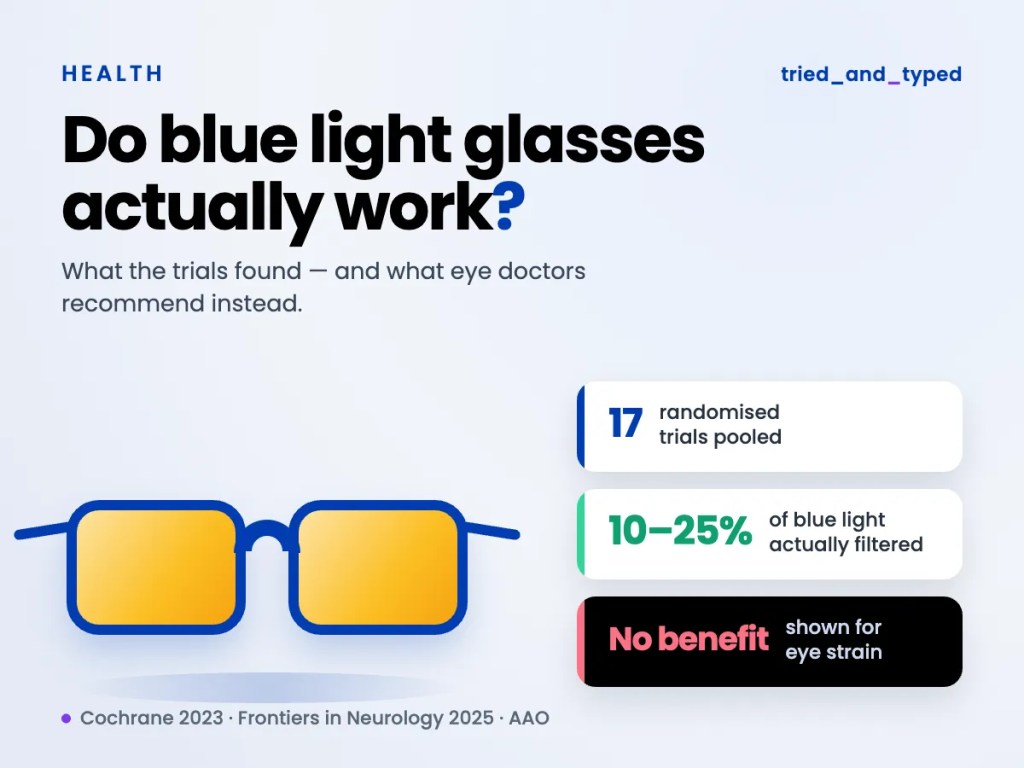
- A Cochrane review of 17 randomised trials found blue-light filtering lenses probably make no difference to eye strain. Certainty of the evidence: low to very low.
- A November 2025 meta-analysis of objective sleep data found no significant effect on how fast you fall asleep or how long you sleep — though it pooled only 49 people.
- The American Academy of Ophthalmology does not recommend them, and points at blink rate, screen distance and glare instead.
- Typical lenses filter 10–25% of blue light. A screen delivers roughly one-thousandth of the blue light you get from daylight.
- They don’t appear to hurt. The case against them is the upcharge and the false reassurance, not the lens.
On this page
- What do blue light glasses actually claim to do?
- What does the evidence say about eye strain?
- Do they help you sleep?
- So what is actually causing the eye strain?
- Should you throw yours away?
What do blue light glasses actually claim to do?
Less than they used to, which is the first interesting thing. Reading the sellers’ own pages on 30 August 2026: Zenni’s Blokz page advertises “40% filtration of blue light” on its core lens and 60% on the anti-fatigue tier, but the only eye-strain claim on the page sits inside a customer testimonial rather than in Zenni’s own copy. Warby Parker’s blue-light page says the lenses filter blue-violet light from screens and stops there — no percentage, no eye-strain promise, no sleep promise.
The strong health claims have migrated out of the brands’ own marketing and into third-party review posts, which is what tends to happen once evidence reviews and advertising regulators catch up. Worth knowing before you read a listicle that still says these lenses “reduce eye strain.”
Two numbers put the physics in perspective. The Cochrane authors note that these lenses typically filter 10–25% of blue light — going meaningfully higher requires an obvious amber tint that shifts every colour you look at. And the blue light your eyes take from a screen is roughly one-thousandth of what they take from ordinary daylight. A walk to the coffee machine outdoors is a bigger blue-light event than a full afternoon at the monitor.
What does the evidence say about eye strain?
The reference point is the Cochrane review by Singh and colleagues, published 18 August 2023: 17 randomised controlled trials, 619 participants, six countries. Its finding on eye strain is that blue-light filtering lenses may not reduce short-term eyestrain from computer work compared with ordinary lenses — no meaningful difference in visual fatigue scores or critical flicker-fusion measurements. Certainty was rated low to very low, with a majority of the trials carrying detection and performance bias.
“Our findings do not support the prescription of blue-light filtering lenses to the general population.”
Associate Professor Laura Downie, one of the review’s authors
The professional bodies say the same thing in plainer language. The American Academy of Ophthalmology states that it “does not recommend any special eye wear for computer use,” and specifically does not recommend blue-light-blocking glasses, on the grounds that there is no evidence blue light damages the eye. In the UK, the College of Optometrists told its members to tell patients directly that there is no strong evidence these lenses improve visual performance or fatigue — and to keep that honesty in their advertising.
Do they help you sleep?
This is the more plausible claim, because the underlying mechanism is real: evening blue light does suppress melatonin and shift circadian timing. The question is whether a pair of lightly tinted lenses moves that needle enough to show up in your sleep.
The newest attempt to answer it is a systematic review and meta-analysis in Frontiers in Neurology (Luna-Rangel et al., 18 November 2025), which pooled only the double-blind crossover trials using actigraphy rather than self-reported sleep. Three trials, 49 participants. Every outcome came back non-significant:
- Sleep onset latency: −4.86 minutes (95% CI −20.23 to 10.52, p = 0.54)
- Total sleep time: +8.75 minutes (95% CI −35.31 to 52.82, p = 0.70)
- Sleep efficiency: −0.61 (95% CI −7.58 to 6.35, p = 0.86)
- Wake after sleep onset: −1.47 minutes (95% CI −14.94 to 11.99, p = 0.83)
Read those confidence intervals rather than the point estimates. Forty-nine people is small, and intervals that wide mean “we cannot tell,” not “definitely nothing.” The authors say as much: larger, standardised trials are still needed. But after fifteen years of this product being sold on the sleep claim, that is a thin body of objective evidence.
The software version of the same idea has been tested more directly. A study in Sleep Health led by BYU’s Chad Jensen put 167 adults aged 18–24 into three groups — phone with Night Shift on, phone with Night Shift off, and no phone before bed — and found no meaningful difference in sleep outcomes between them overall. Among the better-rested participants, the only group that did slightly better was the one that put the phone down. Jensen’s framing is the useful part: when you are lying in bed texting, how much of the alerting effect is the light, and how much is the texting?
So what is actually causing the eye strain?
Mostly the way you use the screen, not the wavelength coming off it. The AAO’s own explanation is blunt: people normally blink around 15 times a minute, and that rate can be cut in half while staring at a display. Halve your blink rate for six hours and your eyes dry out. Dry eyes burn, feel gritty, and blur in a way that clears for a second when you blink — which is exactly the symptom people buy blue-light glasses to fix.
What the same body actually recommends, all of it free:
- Sit about 25 inches — arm’s length — from the screen, and position it so you look slightly downward at it.
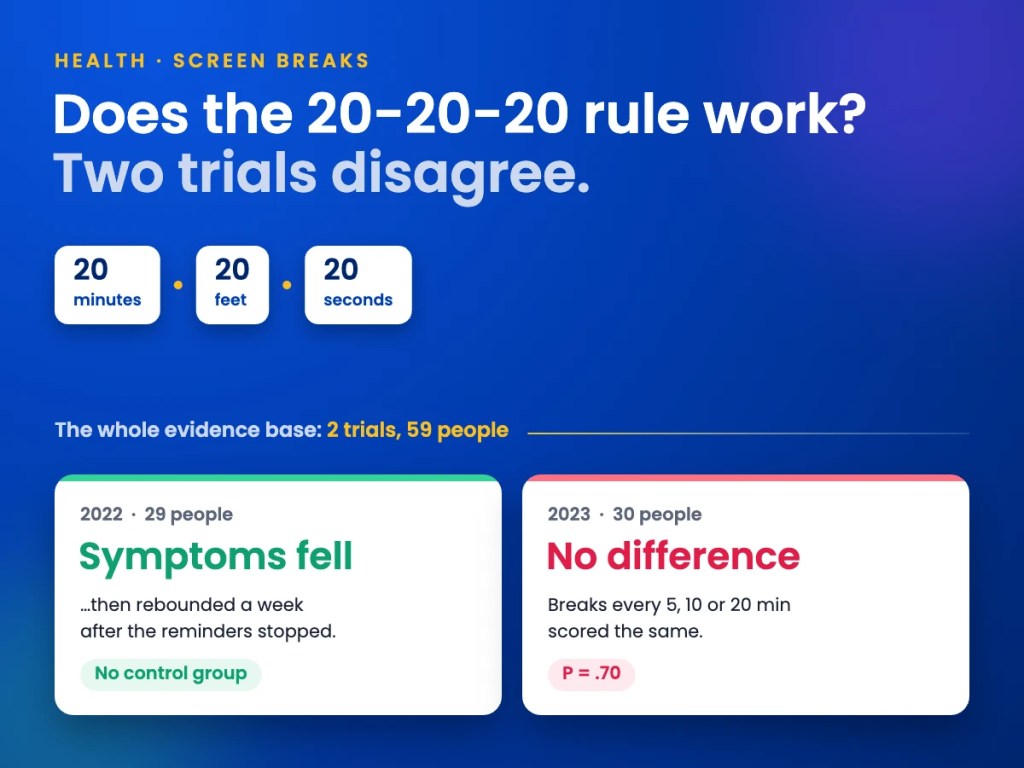
- Follow the 20-20-20 rule: every 20 minutes, look at something at least 20 feet away for at least 20 seconds.
- Use artificial tears when your eyes feel dry.
- Cut glare: dim the lighting near the screen and raise the screen’s contrast rather than its brightness. A matte filter helps on glossy panels.
- If you wear contacts, switch to glasses for part of the day.
It is the same pattern as the treadmill-desk research: the intervention people buy is rarely the one the evidence supports. When we looked at what speed to walk on a walking pad while typing, the confidently repeated numbers turned out to have no citations behind them either.
Should you throw yours away?
No. Nothing in the evidence says these lenses are harmful — the Cochrane review logged a handful of reported adverse effects such as headaches and mood changes, at the same low certainty as everything else. If you already own a pair and you like how they feel, keep wearing them. Expectation effects are real, and a lens you put on as a deliberate “screen time starts now” cue may well be doing something for you, just not the something on the box.
The argument is narrower than “they’re a scam.” It is: don’t pay a coating upcharge on a new prescription for this, and don’t let a pair of glasses stand in for the adjustments that do have evidence behind them.
Before you buy a pair
- Check what your symptom actually is. Burning, gritty, blur that clears when you blink? That is dryness — a blinking and humidity problem, not a wavelength problem.
- Move the monitor to arm’s length with the top of the screen at or just below eye level, before spending anything.
- Put 20-20-20 on a timer rather than on willpower. It fails as a habit and works as an alarm.
- Dim the lamp behind your screen before you turn the screen brightness up.
- Buying anyway? Pay for frames you like and skip the blue-light upcharge — the filtering tier you are paying extra for is the difference between 40% and 60% of a thousandth.
- Strain that persists for weeks, or headaches with vision changes, is worth an optometrist’s appointment. An uncorrected prescription is a far more common cause of screen fatigue than any screen.
Read next: Is sugar-free better than sugar? What research shows — another desk-adjacent swap where the marketing and the evidence part ways.
Sources checked 30 August 2026. This post reports what published research and professional bodies say; it isn’t medical advice, and an optometrist is the right call for symptoms that persist.


 Tried and Typed
Leave a comment