

By A. Akotkar · 31 August 2026
Search “how long should you stand at a standing desk” and the entire first page sells standing desks. That would be fine if their numbers agreed. They don’t — one page lists three different sit-stand ratios as equally “popular,” and the figures across the top results range from 15 minutes a day to six hours. Almost none of them cite a study. Meanwhile the largest piece of research ever run on standing time found something those pages rarely mention: an upper limit.
TL;DR
- The most-quoted target — 2 hours a day of standing and light activity, building to 4 — comes from a 2015 expert statement commissioned by Public Health England, not from a trial.
- A University of Waterloo lab study put the ideal standing-to-sitting ratio between 1:1 and 1:3, or 30 to 45 minutes standing per hour. Over an eight-hour day that is four to six hours.
- A 2024 study of 83,013 adults found that past about 2 hours a day, every additional 30 minutes of standing came with an 11% higher hazard for orthostatic circulatory disease.
- The same study found more standing was not associated with lower cardiovascular risk at all.
- The widely repeated targets sit above the threshold the biggest study flagged. Nobody has reconciled that publicly.
- Every credible source agrees on the thing the ratio debate obscures: movement is the active ingredient, not standing still.
On this page
- What do the standing desk guides actually recommend?
- How long does the research say to stand?
- Is there a point where standing stops helping?
- Does standing cancel out sitting?
- What do ergonomists recommend instead?
- So what should you actually do?
What do the standing desk guides actually recommend?
Whatever you want them to. Reading the top-ranking pages on 31 August 2026, UpDownDesk’s guide recommends two to four hours of standing across an eight-hour day, taken in blocks of 15 to 30 minutes. It then lists three sit-stand ratios as “popular”: 1:1, 2:1 and 1:2. Those are not variations on a theme. Across an eight-hour day they work out to four hours standing, roughly 2.7 hours, and roughly 5.3 hours respectively. The page offers no basis for choosing between them, and attributes its 20/8/2 rule to “occupational health researchers” without naming one.
Desky’s version is more honest about the uncertainty — “there is no hard and fast rule about how long you should stand” — but then asserts that “most experts agree” standing beyond five to six hours in an eight-hour shift is harmful, with no expert named. Its only external citation is a Mayo Clinic page about the risks of sitting, which is a different question.
The pages dated 2026 are mostly the 2015 and 2024 studies recycled with a fresh year in the title. That is worth knowing before you take a number off one of them.
How long does the research say to stand?
Two independent sources, two different answers.
The number you have most likely seen is 4 hours. It traces to a 2015 expert statement in the British Journal of Sports Medicine, commissioned by Public Health England and the Active Working community interest company, which recommended that desk-based workers accumulate two hours a day of standing and light activity, eventually progressing to four. Note the wording: standing and light activity, progressing over time. The vendor pages tend to drop the second half and the progression.
The other number comes from a laboratory study rather than a consensus panel. Jack Callaghan, professor of kinesiology at the University of Waterloo and Canada Research Chair in Spine Biomechanics and Injury Prevention, ran what his university describes as the first lab-controlled study of sit-stand workstations. His conclusion was that the ideal ratio sits between 1:1 and 1:3 standing to sitting — 30 to 45 minutes of standing per hour worked.
“The ideal sit-stand ratio lies somewhere between 1:1 and 1:3 — a vast departure from traditional wisdom.”
Jack Callaghan, University of Waterloo
Callaghan’s point was that the old advice — stand 15 minutes an hour — was too little to do anything. But run his ratio across a normal working day and you land at four to six hours on your feet, which is where the next study becomes a problem.
Is there a point where standing stops helping?
This is the part the desk-selling pages skip. In October 2024, Matthew Ahmadi, Pieter Coenen, Leon Straker and Emmanuel Stamatakis published a study in the International Journal of Epidemiology using device-measured data — accelerometers, not questionnaires — from 83,013 adults, mean age 61.3, followed for years.
Their finding on standing: beyond roughly two hours a day, each additional 30 minutes of standing was associated with an 11% increase in the hazard ratio for orthostatic circulatory disease — the category that includes varicose veins, chronic venous insufficiency and orthostatic hypotension.
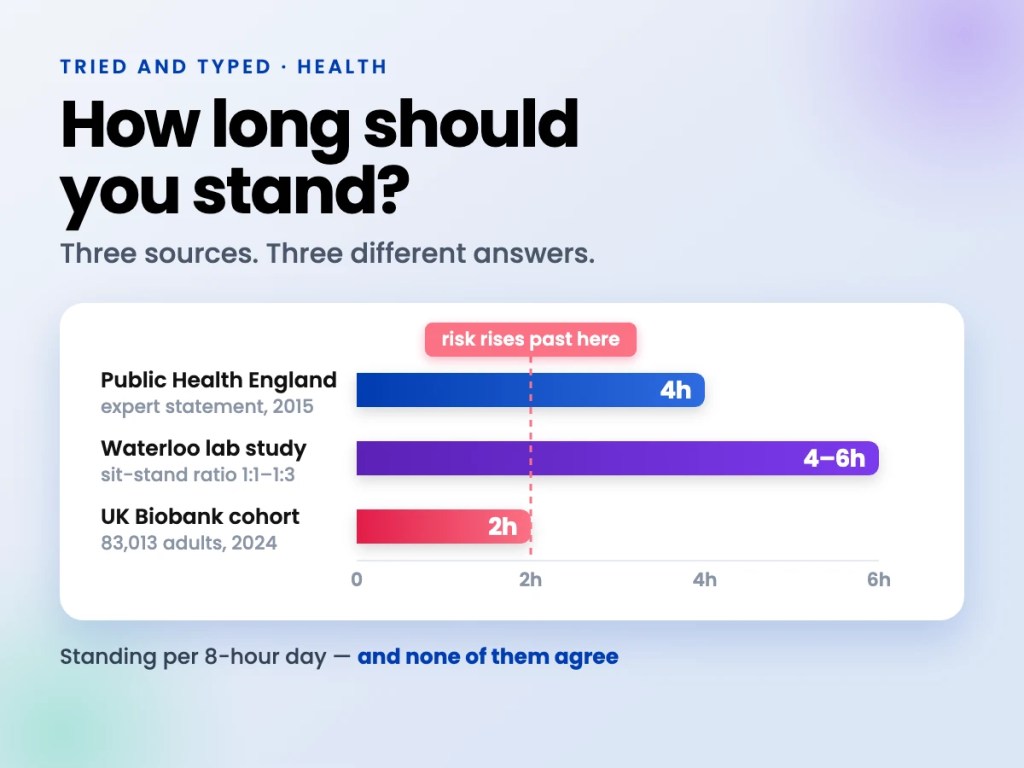
Put the three numbers side by side and the conflict is hard to miss:
- Public Health England expert statement (2015): build up to 4 hours a day.
- Waterloo lab study: 30–45 minutes per hour, so 4–6 hours across a working day.
- UK Biobank cohort (2024): rising orthostatic risk past about 2 hours a day.
Both of the recommendations people repeat sit at or above double the threshold where the largest dataset saw risk climbing. These are different kinds of evidence answering slightly different questions — a consensus statement, a short lab trial and a large observational cohort of older adults are not directly comparable, and the cohort’s mean age of 61 is well above that of the average person shopping for a desk. But nobody selling you a ratio is telling you that the ratio is contested.
Does standing cancel out sitting?
On the evidence so far, no — and this is the finding with the widest implications for anyone who bought a standing desk to undo a desk job.
The same 2024 analysis found that more time spent standing was not associated with a lower risk of major cardiovascular disease. Not weakly associated. Not associated. The authors’ conclusion was direct: standing alone may not be a sufficient strategy for lowering cardiovascular risk, and they cautioned specifically against intervention strategies focused only on replacing sitting time with standing time without increasing physical activity.
That is the mechanism worth understanding. Sitting is not bad because your body is at a particular angle. It is bad because you are not moving. Standing still fixes the angle and not the movement, which is why it does not deliver the benefit people expect from it — and why it introduces a circulatory load of its own. Cornell’s ergonomics group notes that standing work requires around 20% more energy than sitting and that prolonged standing carries its own risks, including varicose veins.
What do ergonomists recommend instead?
Alan Hedge’s guidance at Cornell is the most specific non-commercial protocol available, and it is built around movement rather than posture: sit to do computer work, then every 20 minutes stand for 8 minutes and move for 2. Hedge is explicit that the absolute timings are not the critical part — “the absolute time isn’t critical but about every 20-30 minutes take a posture break and stand and move for a couple of minutes.”
The two-minute movement block is the piece the vendor pages quote least often, because it is the piece a desk cannot sell you. Cornell’s reasoning is that movement is what drives blood circulation through the muscles, and that it takes very little: “you don’t need to do vigorous exercise (e.g. jumping jacks) to get the benefits, just walking around is sufficient.”
Both independent sources converge here. Hedge builds movement into the protocol; Ahmadi and colleagues warn against standing substituted for activity. If you want to add movement rather than just verticality, the treadmill-desk research has its own contested numbers — we looked at what speed to walk on a walking pad while typing, where the confidently repeated figures also turned out to be uncited.
So what should you actually do?
Start from what is not in dispute. No source recommends sitting still for eight hours. No source recommends standing still for eight hours either, and the largest one suggests the second is worse than people assume. Everyone credible recommends changing position regularly and adding movement, and the disagreement is entirely about the ratio in between.
Which means the honest answer to “how long should I stand” is that there is no validated number, and any page that gives you one without a citation invented it. What you can do is stop optimising a ratio nobody has established and optimise the thing all four sources actually agree on.
A sit-stand routine that survives the evidence
- Change posture every 20–30 minutes rather than chasing a daily standing total. The break is the intervention; the total is a number somebody made up.
- Put the two minutes of walking in. It is the only part every source agrees on and the part most routines drop first.
- If you are currently at zero, build up gradually rather than jumping to four hours. The 2015 statement describes a progression, not a starting point.
- Treat 2 hours a day as the point to stop adding, not a target to beat. That is where the biggest dataset saw the risk curve turn.
- Set a timer. Every study here measures behaviour people fail to sustain on intention alone.
- Get an anti-fatigue mat before you extend standing time. Prolonged standing on a hard floor is the version of this with the clearest downside.
- If you have varicose veins, circulatory problems, or feel light-headed when you stand, the orthostatic findings apply to you more than to the average reader — that is a conversation for a doctor, not a blog.
The standing desk is not the mistake. Expecting it to do the work on its own is.
Read next: Do blue light glasses actually work? — another desk purchase where the marketing outran the evidence.
Sources checked 31 August 2026. This post reports what published research and ergonomics groups say; it isn’t medical advice, and persistent pain, swelling or light-headedness is worth a doctor’s appointment.




Leave a Reply