

By A. Akotkar · 5 September 2026
The number that gets repeated is 30 to 40 minutes. Do that much moderate exercise, the story goes, and a ten-hour day at a desk costs you nothing.
That number is real and it comes from a good study. What gets dropped in the retelling is what it measured: risk of dying, across a population, over years. It says nothing about what happens to your legs between nine and lunchtime — and the studies that did look at that reach a less comfortable conclusion.
TL;DR: Partly. Roughly 22 to 40 minutes of moderate activity a day removes the mortality penalty of a sedentary day, and that finding has replicated well. It does not remove the rest. Above about 10.6 hours of daily sitting, heart-failure risk stays elevated in people who already meet the exercise guidelines, and eight weeks of high-intensity training did not stop three hours of sitting from impairing blood-vessel function in the legs. Moving more and sitting less are two different levers.
- How much exercise offsets a day of sitting?
- Does 30 minutes cancel the whole risk?
- What does sitting damage that exercise does not repair?
- Does breaking up the sitting help?
- Is it better to move more or sit less?
- So what should you actually do?
How much exercise offsets a day of sitting?
Between 22 and 40 minutes a day, depending on which study you read. Both figures come from accelerometer data rather than questionnaires, and the newer one is the lower number.
The 30-to-40-minute figure is from a 2020 harmonised meta-analysis in the British Journal of Sports Medicine: nine cohorts, 44,370 people in four countries, all wearing accelerometers rather than filling in questionnaires, followed for between 4 and 14.5 years. Among people in the top third for moderate-to-vigorous activity, the risk of death was not statistically different whether they sat a middling amount or a great deal. The authors put the threshold at “about 30–40 min of MVPA per day” — and noted it was lower than earlier estimates, which had relied on people reporting their own sitting time.

A 2023 analysis of four cohorts in the same journal pushed the number down further. Across 11,989 accelerometer-wearing adults over 50, sitting more than 12 hours a day carried a 38% higher risk of death than sitting 8 — but only among people doing fewer than 22 minutes of moderate-to-vigorous activity. Above 22 minutes, the association went away.
Moderate-to-vigorous means brisk walking, cycling, or anything else that burns three to six times your resting energy. It does not mean a gym session specifically. Both studies measured what the accelerometer saw, not what people signed up for.
So the popular claim is basically right, on its own terms. Those terms are the problem.
Does 30 minutes cancel the whole risk?
No — and the study that shows why is the largest one here.
UK Biobank data on 89,530 people, published in the Journal of the American College of Cardiology, tracked a week of accelerometry against cardiovascular outcomes over roughly eight years. Median sitting time was 9.4 hours a day. Above 10.6 hours, risk inflected: heart failure ran 45% higher (HR 1.45, 95% CI 1.28–1.65) and cardiovascular death 62% higher (HR 1.62, 95% CI 1.34–1.96) than in the reference group sitting 8.2 to 9.4 hours.
Then the sentence that the summaries skip: those associations “persisted among individuals meeting guideline-recommended MVPA levels.” The 150 minutes a week did not buy immunity. Heart failure and cardiovascular death stayed elevated in the people doing everything the guidelines ask.
Atrial fibrillation and heart attack behaved differently — roughly linear with sitting time, no threshold, smaller effects (HR 1.11 and 1.15). There is no single dose-response curve for “sitting.” Different outcomes have different shapes, which is one reason the headlines contradict each other so freely.
What does sitting damage that exercise does not repair?
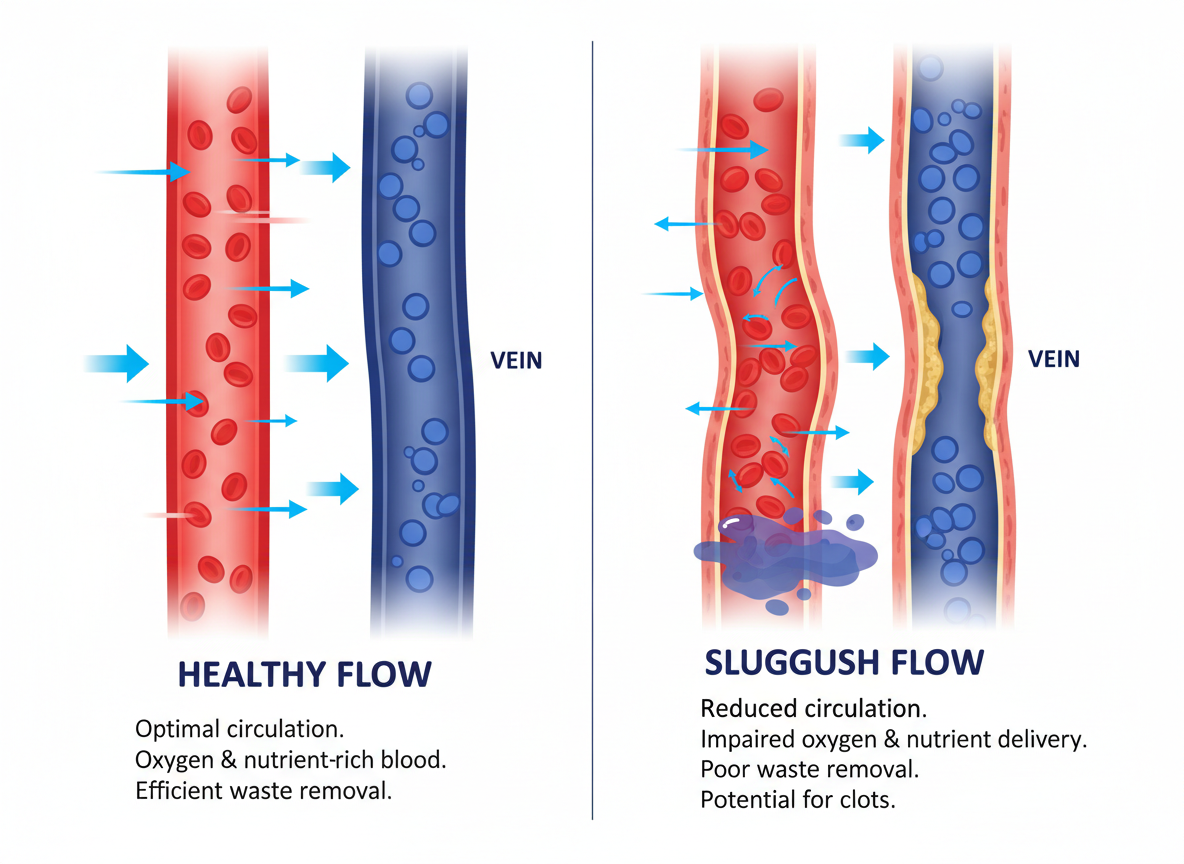
The lining of the blood vessels in your legs, within about three hours.
An April 2026 trial in Experimental Physiology tested this directly. Twenty-two healthy young adults were randomised to eight weeks of Tabata-style high-intensity interval training, four sessions a week, or to a control group. Before and after, both groups sat for three hours while researchers measured flow-mediated dilation in the popliteal artery — the standard test of whether a blood vessel can widen on demand.
Sitting reduced blood flow and shear rate in both groups, before and after training. Popliteal FMD dropped after sitting at baseline in both groups, and it still dropped in the trained group after eight weeks of HIIT. The conclusion is flat: eight weeks of high-intensity training “does not prevent sitting-induced impairments in endothelial function or microvascular function.” Four Tabata sessions a week for two months is more training than most desk workers manage in a year. The three hours of sitting did its work either way.
Two honest qualifications, because this is a small study and one result cuts the other way. Twenty-two young, healthy participants is not a population. And post-sitting FMD at week 8 was higher in the trained group than in controls once baseline was adjusted for — the training raised the floor without stopping the fall. A July 2026 paper in the Journal of Sports Sciences points the same way, finding that habitual moderate-to-vigorous activity attenuates the vascular hit from acute sitting.
Attenuates, not prevents. That is the honest summary of the whole literature: fitness makes the hole shallower, and you still fall in.
Does breaking up the sitting help?
Yes, more reliably than the exercise does — though not uniformly across every measure.
A systematic review published on 4 September 2026 in Frontiers in Cardiovascular Medicine pooled 24 studies of interrupting prolonged sitting, screened to PRISMA and quality-scored on the PEDro scale. Interrupting sitting generally improved peripheral haemodynamics, and the effect was clearest where the damage is clearest: lower-limb blood flow and shear rate.
Flow-mediated dilation was messier. The review found FMD responses heterogeneous, depending on which artery was measured, who the participants were, and how big the interruption dose was. That heterogeneity is real and worth saying out loud rather than rounding to “breaks fix it.”
The mechanism is not mysterious, and it explains why the intervention works where it does. Sitting still reduces the shear stress of blood moving along the vessel wall in the legs. Standing up restores it. That is also why the answer to a related question — does standing at a desk cancel out sitting — is more about the transition than the posture.

Is it better to move more or sit less?
Move more, if you can only do one. But the gap is smaller than the effort involved suggests.
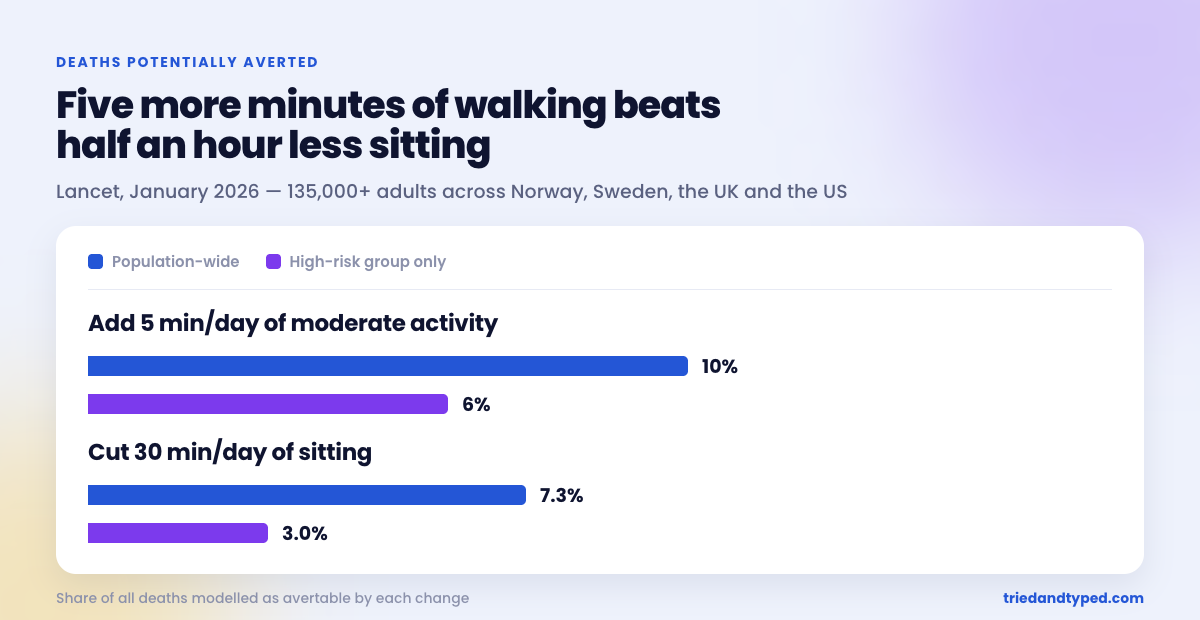
A January 2026 individual-participant meta-analysis in The Lancet02219-6), pooling more than 135,000 people across Norway, Sweden, the UK and the US, modelled small realistic changes rather than aspirational ones. Adding 5 minutes a day of moderate-to-vigorous activity was estimated to avert up to 6% of deaths in a high-risk approach and 10% across the population. Cutting 30 minutes a day of sitting averted 3.0% and 7.3% respectively.
Five minutes of walking beats half an hour less sitting, per unit of time. The point of the paper is that both figures come from changes small enough that people might actually make them.
The UK Biobank data supports the second lever too, in the group that needs it most. Among people already sitting more than 10.6 hours a day, reallocating 30 minutes of sitting to anything else cut heart-failure risk (HR 0.93, 95% CI 0.90–0.96) — and it still did so among those meeting the activity guidelines (HR 0.93, 95% CI 0.87–0.99). Exercisers get something from sitting less that their exercise was not already giving them.
So what should you actually do?
I have no first-hand test to offer here; this is a reading of the primary literature, not a routine I ran. What the studies support:
- Get 22 minutes of moderate activity a day, minimum. That is the level where the mortality association disappears in the accelerometer data, and it is the single highest-value thing on this list.
- Treat 10 hours of sitting as the line worth watching. Risk inflects at 10.6, and exercise does not move that inflection.
- Break the sitting up, not just the day. Lower-limb blood flow responds to standing up; it does not care that you cycled at 7am.
- Don’t trade one for the other. Meeting the exercise guidelines still leaves risk on the table above 10.6 hours, and cutting 30 minutes of sitting still helps people who already exercise.
- Be sceptical of any single number, including the ones here. The threshold moved from 40 minutes to 22 in three years, and different cardiovascular outcomes have differently shaped curves.
If you’re picking a way to do the “sit less” half, the walking pad speed that actually lets you keep typing is a narrower question with a more definite answer than this one.





Leave a Reply