

By Ashish Akotkar · 31 August 2026
Heathrow scrapped its 100ml liquid rule at the end of January 2026 after a reported £1 billion scanner upgrade, and headlines have made it sound like the whole 3-1-1 routine is dying across Europe. It isn’t. Schiphol’s own security page, checked directly for this post, still says liquids “may only be carried in containers holding max. 100ml.” Manchester and Luton are the same. The real picture is a patchwork that changes airport by airport, and sometimes lane by lane inside the same terminal — which means the country you’re flying to or from tells you almost nothing.
TL;DR: A handful of UK and EU airports now let you carry liquids in containers up to two litres through security, without a clear plastic bag. Most airports, including some major EU hubs, still cap you at 100ml. The split depends on which generation of CT scanner is installed and certified at that specific checkpoint — not on Brexit, and not on which country you’re in. Check your actual departure and return airports before you pack, and if you’re connecting through the US, TSA’s 100ml rule hasn’t moved at all.
Table of contents
- Why does the 100ml rule still exist anywhere?
- Which UK airports have dropped the 100ml limit?
- Which EU airports allow more than 100ml — and which don’t?
- What’s the catch if my return airport hasn’t upgraded?
- What about vacuum flasks, connections, and US-bound flights?
- Before you pack: a quick checklist
Why does the 100ml rule still exist anywhere?
The 100ml limit was never permanently retired — it was briefly relaxed, then reimposed. Early CT (“C3”) scanners were allowed to screen larger liquid containers, but the European Commission walked that back with Commission Implementing Regulation (EU) 2024/2108, effective 1 September 2024, which reimposed the 100ml-per-container limit on that generation of equipment over unresolved detection-reliability concerns. Airport trade body ACI Europe said at the time that no timeline had been set for lifting the restriction, after airports had already spent roughly eight times the cost of a standard X-ray machine on the newer scanners.
Since then, newer scanner models have cleared certification for the higher limit — aviation trade press has named Smiths Detection’s Hi-Scan 6040 CTiX as one of them — which is why the airports moving to two litres are the ones that installed and certified that specific hardware, not every airport in a given country. In the UK, the Department for Transport runs its own certification process independent of the EU regulation, which is the actual reason UK airports have moved faster than most EU ones — it isn’t a Brexit dividend so much as a different regulator making a different call on the same technology.
Which UK airports have dropped the 100ml limit?
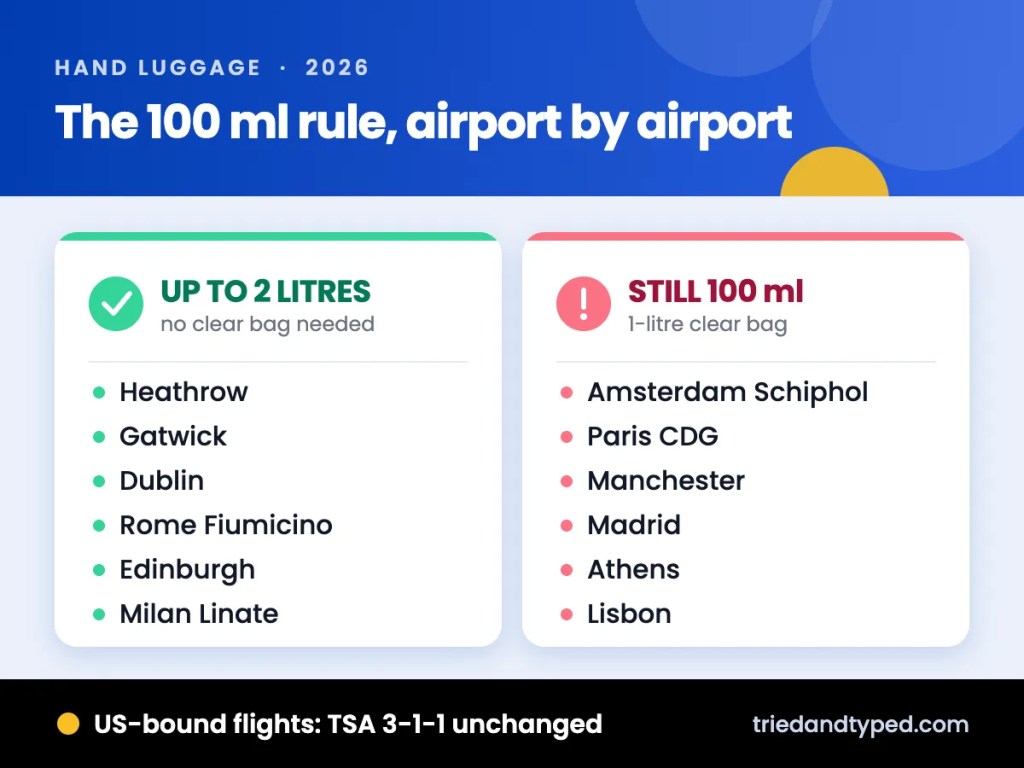
As of Which?’s 2026 airport-by-airport tracker, seven UK airports allow up to two litres of liquid per container, with no limit on how many containers you bring: Heathrow, Gatwick, Edinburgh, Birmingham, Bristol, Belfast International, and Belfast City. Heathrow’s rollout across all terminals finished around 26–27 January 2026, reportedly after a £1 billion investment in new scanners (Forbes). Manchester and Luton still enforce the 100ml limit — passengers there don’t need the transparent resealable bag anymore, but the 100ml-per-container cap remains.
Which EU airports allow more than 100ml — and which don’t?
Rome Fiumicino, Milan Linate, Milan Malpensa (Terminal 1), Bologna, and Dublin have converted fully. Frankfurt, Munich, and Berlin Brandenburg are mid-rollout, with only a fraction of security lanes upgraded — one report put Frankfurt at roughly 40 of 160 lanes, meaning the higher limit is a coin flip depending which checkpoint you’re routed through. Madrid and Barcelona reportedly have the newer scanners installed but haven’t activated the higher limit pending certification. Paris, Athens, and Lisbon are still on 100ml, with upgrade targets ranging from 2027 to as late as 2030 for some terminals.
Amsterdam Schiphol is still 100ml as well — its own security guidance, current as of this post, states liquids “may only be carried in containers holding max. 100ml” and must go in a transparent resealable one-litre bag. If you’re departing from or connecting through Schiphol, pack for the old rule. That’s worth flagging alongside where ETIAS actually stands right now — another EU travel rule that’s easy to get wrong if you go by headlines instead of checking the specific airport or authority involved.
What’s the catch if my return airport hasn’t upgraded?
The higher limit only applies to the security checkpoint you’re actually walking through, on that specific flight. It is not a status that follows you. If you fly out of Heathrow with a 500ml bottle in your carry-on, and your return flight departs from an airport still running 100ml — which, going by the lists above, is most of them — that bottle gets confiscated on the way back. Airport guidance and consumer reporting are consistent on this point: check the rules for every airport on your itinerary, not just the one you’re most focused on.
What about vacuum flasks, connections, and US-bound flights?
Even at airports running the higher limit, insulated vacuum flasks and double-walled bottles usually still need to be emptied before screening — CT scanners can’t image liquid through that kind of insulation, so it gets treated as an opaque container regardless of the volume rule. If your itinerary includes a connection through an airport that hasn’t upgraded, pack to the lower limit for the whole trip; there’s no practical way to “top up” once you’ve already cleared one checkpoint.
None of this touches flights to the United States. TSA’s own current guidance, unchanged as of this post, is still the standard 3-1-1 rule: containers of 3.4oz/100ml or less, all fitting in a single quart-sized bag. A two-litre bottle that cleared security in Rome or Dublin will not clear security at a US airport, and in practice most airlines flag this at the gate on US-bound routes regardless of what your departure airport allowed.
Before you pack: a quick checklist
- Look up your specific departure airport by name — not just the country — for its current liquid limit.
- Do the same for your return and any connecting airport, separately. Don’t assume symmetry.
- If any leg touches the US, or any airport on your route is still on 100ml, pack the whole trip to that standard.
- Vacuum flasks and insulated bottles: empty them before security, even at upgraded airports.
- When in doubt, check the airport’s own website the week of travel — rollouts are still moving, and lane-level coverage changes faster than most travel articles get updated.
Sources checked directly for this post on 31 August 2026: the EU regulation text on EUR-Lex, TSA.gov, and Schiphol’s own security guidance.





Leave a comment