

By Ashish Akotkar · 3 September 2026
The 2026 Edelman Trust Barometer special report on health asked more than 16,000 people across 16 countries about six debunked health claims. Seven in ten believed at least one of them.
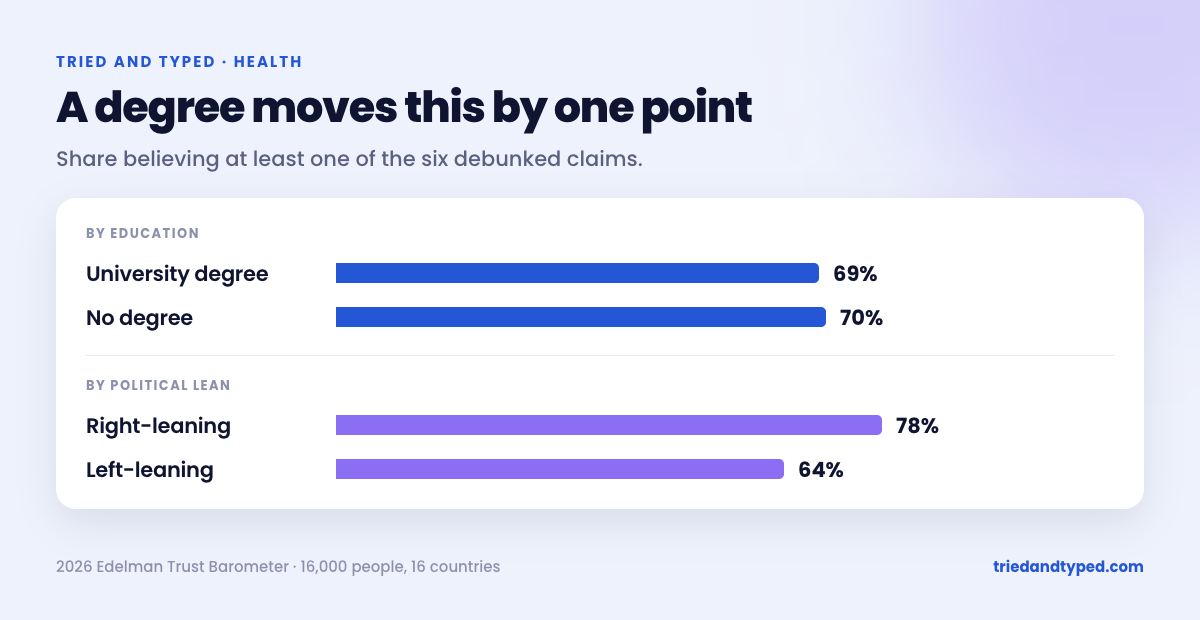
The uncomfortable part is not the headline number. It is that 69% of people with a university degree believed at least one, against 70% of those without. Whatever is going on here, it is not a knowledge deficit that education fixes.
So here are the six, in the order the survey ranked them, with what the evidence actually shows. One of them is more defensible than the framing suggests, and I have said so rather than pretending the score is 6-0.
- Is animal protein healthier than plant protein?
- Is fluoride in tap water harmful?
- Do childhood vaccines carry more risk than benefit?
- Is raw milk healthier than pasteurised?
- Does paracetamol in pregnancy cause autism?
- Are vaccines used for population control?
- Why does education not help?
- So what should you actually do?
Is animal protein healthier than plant protein?
Believed by 32%.
For the outcomes most people care about, the evidence points the other way. A systematic review of randomised trials and prospective cohorts found that substituting plant protein for animal protein was associated with lower cardiovascular mortality and lower type 2 diabetes incidence, and trial meta-analyses show improvements in total and LDL cholesterol when you make that swap. Legumes, nuts, seeds and whole grains come out ahead of red and processed meat on essentially every cardiometabolic measure.
There is one real exception, and it is worth knowing if you lift: for building and holding muscle mass, animal protein has a modest edge in the trial data, though soy isolate performs comparably even in older adults. “Better for muscle accrual” is a narrow claim. “Healthier” is a much broader one, and it does not hold.

Is fluoride in tap water harmful?
Believed by 32%. This is the one where the honest answer has moved.
The claim as surveyed — that fluoride is harmful — is not supported at the levels used in public water. But the science genuinely shifted in the last two years, and pretending otherwise would be the same sin the claim is guilty of.
In 2024 the US National Toxicology Program concluded with moderate confidence that fluoride exposure above 1.5 mg/L is associated with lower IQ in children. Below that level, the data were inconclusive. The European Food Safety Authority reached a similar conclusion in 2025. US community water fluoridation targets 0.7 mg/L — less than half the level where the signal appears — but the EPA’s legal ceiling is still 4 mg/L, and the agency opened a review in 2025 that may lower it toward 1.5.
The “unhelpful” half of the claim has more going for it. A 2024 Cochrane review found water fluoridation prevents fewer cavities today than in studies before 1975, for a mundane reason: nearly everyone now uses fluoride toothpaste, so the marginal benefit of adding it to water has shrunk.

Verdict: not harmful at the concentrations actually used, meaningfully less useful than it was in 1970, and the only one of the six where “the science is still moving” is a fair thing to say.
Do childhood vaccines carry more risk than benefit?
Believed by 31%.
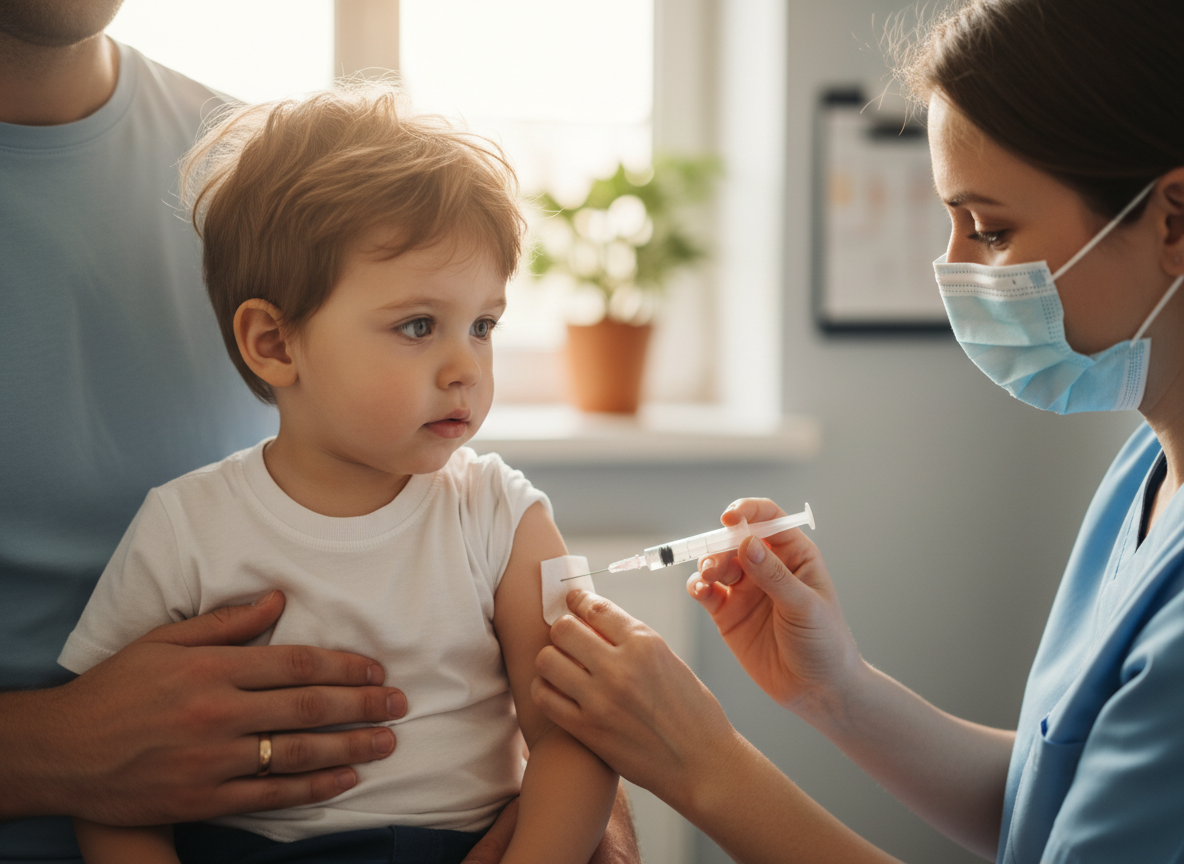
No. This is among the most heavily studied questions in medicine, across tens of millions of children and multiple independent health systems, and the benefit-to-risk ratio is not close. Serious adverse events are real, documented and rare; the diseases prevented are neither rare nor mild when they return, as every measles resurgence in a low-coverage community demonstrates on schedule.
Is raw milk healthier than pasteurised?

Believed by 28%.
Pasteurisation kills pathogens without meaningfully changing milk’s nutritional content — that is the finding across multiple studies, and there is no evidence of a nutritional benefit to drinking it raw. What raw milk does reliably deliver is risk. CDC outbreak data records 202 outbreaks between 1998 and 2018, causing 2,645 illnesses and 228 hospitalisations, including Guillain-Barré syndrome and haemolytic uraemic syndrome.
The ratio is what makes this stark. Raw milk is consumed by roughly 3.2% of the US population and accounts for the majority of illness from contaminated dairy.
Does paracetamol in pregnancy cause autism?

Believed by 25%.
Some early observational studies did find small associations, which is why this one has staying power. Then researchers ran the study design that can actually separate cause from family background: a Swedish cohort of nearly 2.5 million births with sibling controls, comparing siblings where one was exposed in the womb and one was not.
The association disappeared entirely. When the comparison holds genetics and family environment constant, exposed and unexposed siblings show no difference in autism diagnosis. A Lancet study in January 2026 reached the same conclusion, and FIGO’s position is that the evidence does not support a causal link.
This is a good illustration of why “a study found a link” is a weak sentence on its own. The original associations were most likely picking up the reasons people take paracetamol — fever, infection, pain — and the heritable traits shared within families.
Are vaccines used for population control?
Believed by 25%.
There is no evidence for this, and it is the only claim of the six that is not an empirical question that went the wrong way. It is a conspiracy narrative, and it travels on distrust of institutions rather than on any misread study.
Why does education not help?

This is the finding worth sitting with. Degree holders believed at least one claim at 69%, non-degree holders at 70%. Political lean moved it more — 78% on the right, 64% on the left — but not nearly enough to make this a story about one group being fooled.
Which suggests these beliefs are not sitting in the same mental slot as facts you learned and could be re-taught. They arrive attached to identity, to who you trust, and to a reasonable-feeling instinct that natural is safer than processed. That instinct is right often enough to survive being wrong here.
If you want a practical filter, the useful question is rarely “is there a study?” It is “what would this look like if the claim were false, and has anyone checked?” The paracetamol case is the model: the sibling design was built specifically to answer that, and it did.
So what should you actually do?
- Assume you hold at least one of these. Seven in ten people do, and your degree is not the protection you think it is
- Treat “a study found a link” as the beginning of a question, not the end of one – ask whether anyone controlled for the obvious confounders
- Check the dose before accepting a harm claim: fluoride at 1.5 mg/L and fluoride at 0.7 mg/L are different questions with different answers
- Notice when a claim is doing identity work rather than factual work – those are the ones evidence bounces off
- Update out loud when the science moves, as it genuinely has on fluoride’s marginal benefit. Refusing to concede the defensible part is what makes the indefensible parts sticky
Related reading: Is Sugar-Free Better Than Sugar? works through the same evidence problem on sweeteners, and Do Blue Light Glasses Actually Work? does it for a product claim that turned out to have no trial evidence behind it.





Leave a Reply