

By A. Akotkar · 15 September 2026
Does the 20-20-20 rule work? Every 20 minutes, look at something 20 feet away for 20 seconds. It is on the American Optometric Association’s website, on most eye clinics’ blogs, and in the advice this site gave about blue light glasses.
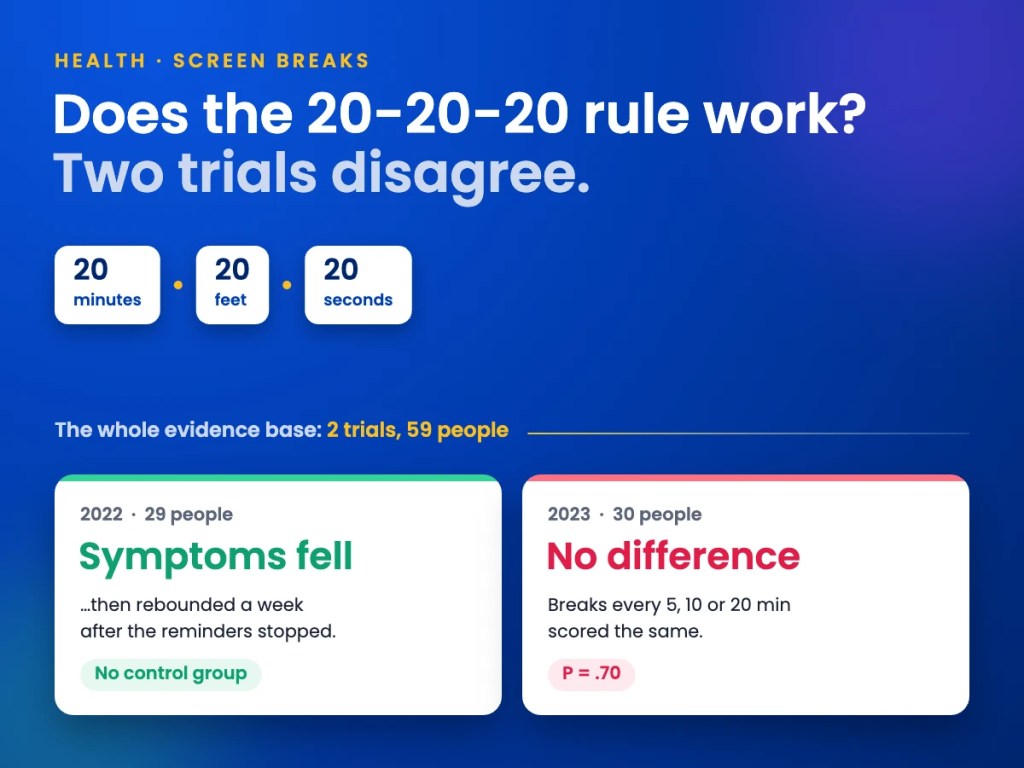
The evidence behind it is two small trials, 59 people between them. They reached opposite conclusions.
This is not medical advice. It is a reading of the published studies on a comfort habit. Eye symptoms that persist, or that change your vision, are a reason to see an optometrist, not to adjust your break timer.
TL;DR: A 2022 trial of 29 symptomatic computer users found that 20-20-20 reminders reduced eye strain and dry eye symptoms over two weeks, and the improvement was gone a week after the reminders stopped. A 2023 trial of 30 young adults found that 20-second breaks every 5, 10 or 20 minutes made no difference to symptoms, reading speed or accuracy. Neither tested the numbers themselves. The rule is cheap and harmless, and the evidence for it is thinner than its popularity suggests.
- Does the 20-20-20 rule work?
- What did the two trials actually find?
- Why don’t the surveys settle it?
- Why 20 feet and 20 seconds?
- What else do eye care organisations recommend?
- So should you bother with the 20-20-20 rule?
Does the 20-20-20 rule work?
Maybe, modestly, while you keep doing it. That is as far as the evidence goes.
The rule is credited to optometrist Jeffrey Anshel, who proposed it in the late 1990s, according to a review in Modern Optometry. It spread because it is easy to remember, not because anyone had tested it. When Johnson and Rosenfield set out to test it in 2023, their stated purpose conceded that “there is relatively little peer-reviewed evidence to support this rule.”
That is still broadly true. There are two prospective trials, a handful of surveys, and a lot of confident blog posts citing the one trial that agreed with them.
What did the two trials actually find?
One found a benefit that faded. The other found no benefit at all.
The trial that says yes. Talens-Estarelles and colleagues, in Contact Lens and Anterior Eye, put webcam software on the laptops of 29 computer users who already had symptoms. The software tracked their gaze and blinking, and reminded each of them to take 20-20-20 breaks. After two weeks, people took more breaks per day and worked in shorter stretches. Their digital eye strain and dry eye symptom scores went down.
Then the less-quoted half. One week after the reminders stopped, the improvement had not held. Two weeks also changed none of the measurable signs on the eye’s surface or tear film, and none of the binocular vision measures except one, accommodative facility. The abstract describes a before-and-after comparison within the same group, with no separate control group, so some of the improvement could come from people simply paying attention to their eyes for a fortnight.
The trial that says no. Johnson and Rosenfield, in Optometry and Vision Science, gave 30 young adults a demanding 40-minute reading task on a tablet, four times. Each session allowed 20-second breaks at a different interval: every 5, 10 or 20 minutes, or not at all. Symptoms rose after every session (P < .001). The break schedule made no significant difference to symptoms (P = .70), reading speed (P = .93) or accuracy (P = .55). Their conclusion was blunt: the results “do not support the proposal of using 20-second scheduled breaks as a therapeutic intervention.”
The two designs are different enough that both results can be true. One followed symptomatic people through two weeks of ordinary work. The other ran healthy young adults through 40 minutes in a lab, where the 20-minute arm got a single break. Anshel responded to the 2023 study in a letter to the journal.

Why don’t the surveys settle it?
Because they can’t tell which way the arrow points.
A survey of 796 Peruvian nursing students during remote learning in 2021 found digital eye strain in 87.6% of them. Students who did not follow the 20-20-20 rule had 2.6 times the odds of eye strain (95% CI: 1.25–5.20). That reads like support for the rule.
A survey of 432 people in India, published in the Indian Journal of Ophthalmology in 2023, points the other way. Only 34% practised the rule at all, 38 regularly and 109 occasionally. The people with burning eyes and headaches were the ones who tended to practise it.
Both are plausible. The rule might prevent symptoms. Symptoms might also send people looking for the rule. A survey taken at one point in time can’t separate the two. The Modern Optometry review describes the Indian findings as burning and headaches decreasing in the rule-following group. That is not what the study’s abstract says, so this post follows the abstract.
Why 20 feet and 20 seconds?
20 feet is a real optical convention. 20 seconds is not a tested number.
How hard the eye works to focus is measured in dioptres: one divided by the viewing distance in metres. A screen at 25 inches (0.64 m) asks for about 1.6 dioptres. An object 20 feet away (6.1 m) asks for about 0.16. Twenty feet is roughly where the eye’s focusing demand gets close to zero, which is also why eye charts are read from that distance, and why normal vision is called 20/20.
The distance is not a cliff edge. By that same arithmetic, which is mine rather than any study’s, a wall 10 feet away removes about 79% of the focusing demand of a 25-inch screen, against about 90% at 20 feet. Looking across the room gets you most of the way.
The duration and the interval have no comparable backing. Johnson and Rosenfield varied how often breaks came, holding each one at 20 seconds, and found no difference. Neither trial compared 20 seconds with a minute, or with five.
It is also worth being clear that focusing is not the whole story. The American Academy of Ophthalmology notes that people normally blink about 15 times a minute, and only about 5 to 7 times a minute at a computer. That is a dry eye problem, not a focusing one, and staring at a distant object doesn’t automatically fix it.
What else do eye care organisations recommend?
More than the one rule, and some of it is about the desk rather than the break.
The American Optometric Association’s computer vision syndrome page includes the 20-20-20 rule. It also recommends:
- A longer rest: 15 minutes after two hours of continuous computer use. Neither trial tested this.
- Screen position: the centre of the screen 15 to 20 degrees below eye level, about 4 or 5 inches, and 20 to 28 inches from the eyes.
- Blinking: blink often, to keep the front of the eye moist.
The AAO puts the distance at about 25 inches, roughly arm’s length. It also states plainly that screen use does not permanently damage your eyes.
Screen angle is where some optometrists now want the emphasis. A piece by four optometrists on Eyes On Eyecare argues for a “20° rule” instead: set the screen so your gaze falls about 20 degrees below horizontal, because looking upward exposes more of the eye and encourages incomplete blinks. That is an argument from the ergonomics literature, not a trial of the rule, and it is worth reading as such.
So should you bother with the 20-20-20 rule?
I haven’t tested it myself, so this rests on the studies above rather than any before-and-after of my own. What the evidence supports:
- Do it if it helps you, and expect a modest effect. The one positive trial found symptom relief, not changes to the eye itself.
- Use a reminder, not willpower. The positive result came from software prompts, and the benefit faded within a week of switching them off.
- Don’t measure out 20 feet. Across the room gets most of the focusing benefit.
- Fix the screen before you fix the schedule. Centre it 15 to 20 degrees below eye level and 20 to 28 inches away.
- Take the longer break too. The AOA’s 15 minutes every two hours is a separate recommendation, and an easier one to notice skipping.
- Blink on purpose. Screen use can cut your blink rate by more than half, and a distance glance doesn’t restore it.
- See an optometrist if symptoms persist. A break rule is a comfort habit, not a fix for an uncorrected prescription.
For what the evidence says about the other popular fix for screen eye strain, see whether blue light glasses actually work.
 Tried and Typed
Leave a comment