


By A. Akotkar · 7 September 2026
No. The EU free cabin bag rule was adopted in July 2026 and applies to nobody yet.
That would be a dull correction on its own. The interesting part is that the headline gets the swap backwards in both directions: the free bag people are celebrating has existed since the summer of 2025 and is not a law, and the thing that actually became law is not free.
TL;DR: Parliament approved the revised air passenger rights regulation on 7 July 2026 and the Council cleared it on 13 July. It enters into force 20 days after publication in the Official Journal, then gives airlines a year to prepare — so realistically late 2027. What you can carry free today is a 40 × 30 × 15 cm personal item, which A4E member airlines adopted voluntarily in 2025. The larger cabin bag is not made free by the new rule; it has to be included in the advertised base fare, which is a different thing. Compensation stays at three hours and €250–€600.
- Is the EU free cabin bag rule in force yet?
- What can you actually carry free today?
- What will the new rule guarantee?
- Did flight delay compensation change?
- What changed that nobody reported?
- So what should you actually do?
Is the EU free cabin bag rule in force yet?
No, and the gap is longer than most coverage suggests.
The European Parliament approved the joint text on 7 July 2026 by 646 votes to 12, with 3 abstentions — the end of a thirteen-year deadlock over revising Regulation 261/2004. The Council gave final clearance on 13 July.
Then it stops. The regulation enters into force 20 days after it is published in the Official Journal, and airlines get a further year to prepare before the rules bite. At the time of writing I cannot find the final act in the Official Journal at all, which puts the earliest realistic application somewhere in late 2027.
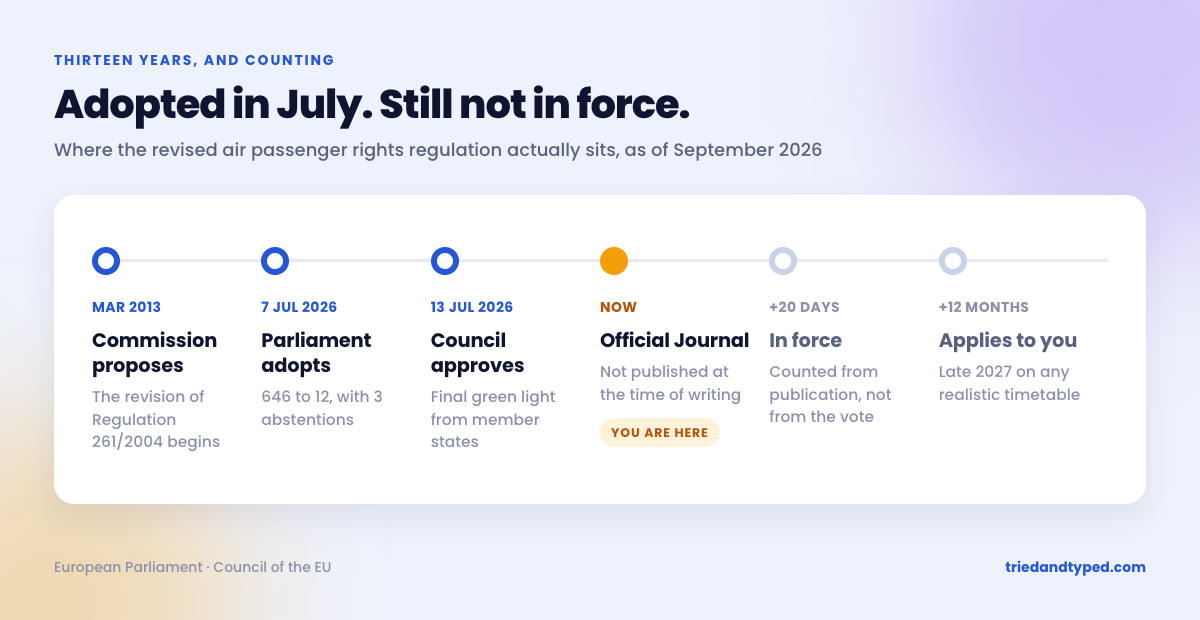
Worth noting where the primary sources disagree, because they do. Parliament’s own Legislative Train tracker still listed the file as “close to adoption” on 1 August 2026 — three weeks after the Council had adopted it. The Legislative Observatory likewise still shows the act unpublished. I have gone with the Council’s own press release over Parliament’s trackers, on the grounds that the institution announcing its own vote is the better witness to it, but the trackers are the reason so much coverage is vague about where this actually stands.
What can you actually carry free today?
One personal item, up to 40 × 30 × 15 cm, on most European airlines — and it is not the new rule that gives it to you.
Airlines for Europe announced on 2 July 2025 that its member airlines would guarantee that size for the under-seat personal item, rolled out “by the end of the 2025 summer season.” A4E’s members include the large European groups, so in practice this covers most of the flights people are asking about.
Two things follow, and both matter more than the dimension itself. It is a voluntary industry commitment, not a legal entitlement — nothing stops a member leaving the association or a non-member ignoring it. And A4E was explicit that “carriers will continue to permit larger personal items at their discretion,” so the 40 × 30 × 15 figure is a floor, not a ceiling.
The number is the same one the new regulation uses. That is not a coincidence, and it is the single most misreported fact in this story: the law is catching up to what the airlines already agreed to do, rather than forcing something new out of them.
What will the new rule guarantee?
A free personal item, and a cabin bag that is priced in rather than free.
The free half is the personal item — a handbag, laptop bag or small backpack that fits under the seat in front, at no extra charge. Parliament’s own release describes it only as “one personal item, such as a small bag or backpack” without stating dimensions; the 40 × 30 × 15 figure attached to it in the reporting matches the A4E standard already in use.
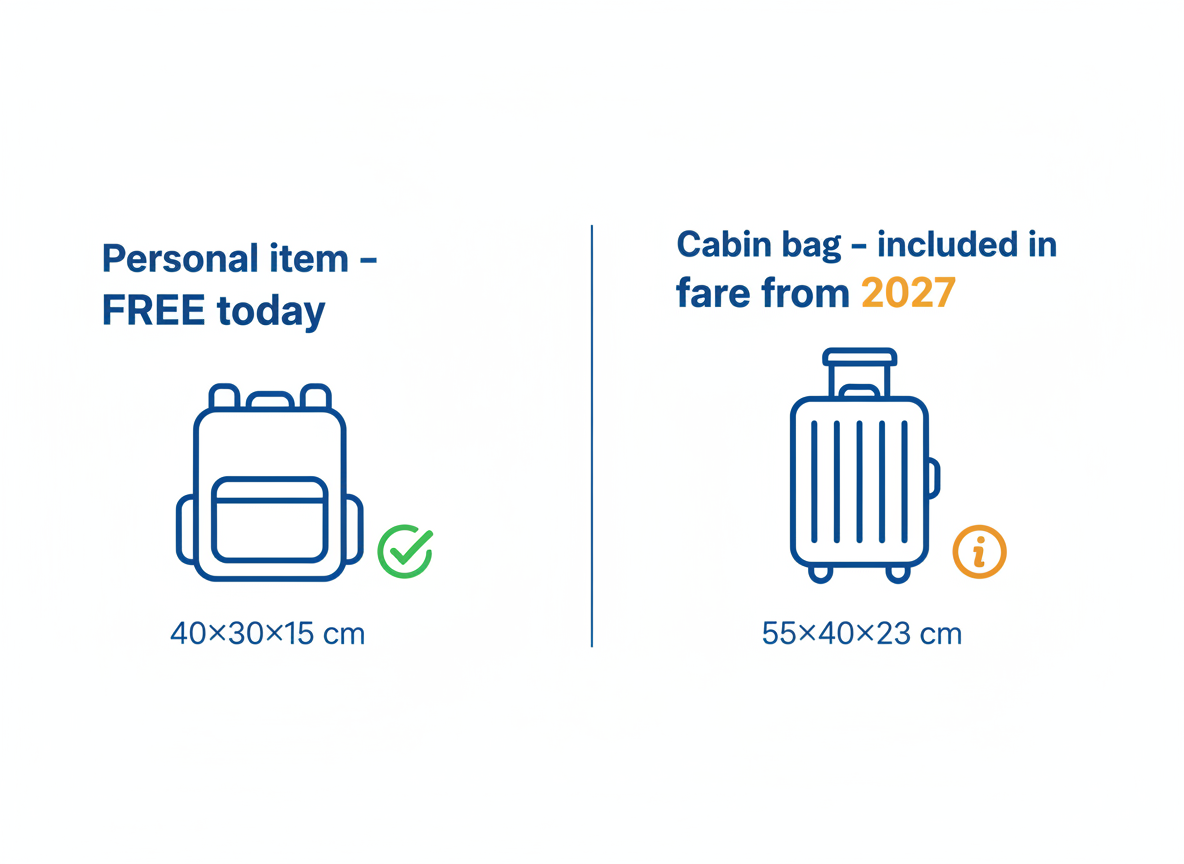
The larger cabin bag works differently, and this is where “free cabin bags” falls apart. Airlines must include the cabin bag in the fare they advertise from the start of the booking process. They may still sell a cheaper fare to someone who chooses to travel without one. So the guarantee is about price transparency — you can no longer be shown a headline fare that quietly excludes the bag — not about the bag costing nothing. A budget carrier can comply by raising the advertised price and offering a bagless discount, which several have already said they intend to do.
Whether that leaves you better off depends entirely on whether you were buying the bag anyway.
Did flight delay compensation change?
No, and that is the outcome passengers wanted.
This was the hardest-fought part of the file. The Council pushed for years to raise the delay threshold from three hours to four or six, depending on distance, which would have removed compensation from a large share of currently eligible flights. Parliament refused. The final text keeps the three-hour trigger and the existing amounts:
- €250 for journeys up to 1,500 km
- €400 for intra-EU journeys over 1,500 km, and other journeys between 1,500 and 3,500 km
- €600 for all other longer journeys
Cancellations notified within 14 days of departure also qualify. There is one carve-out worth knowing: a 50% reduction is possible on the longest routes where the passenger is rerouted or the delay comes in under four hours.
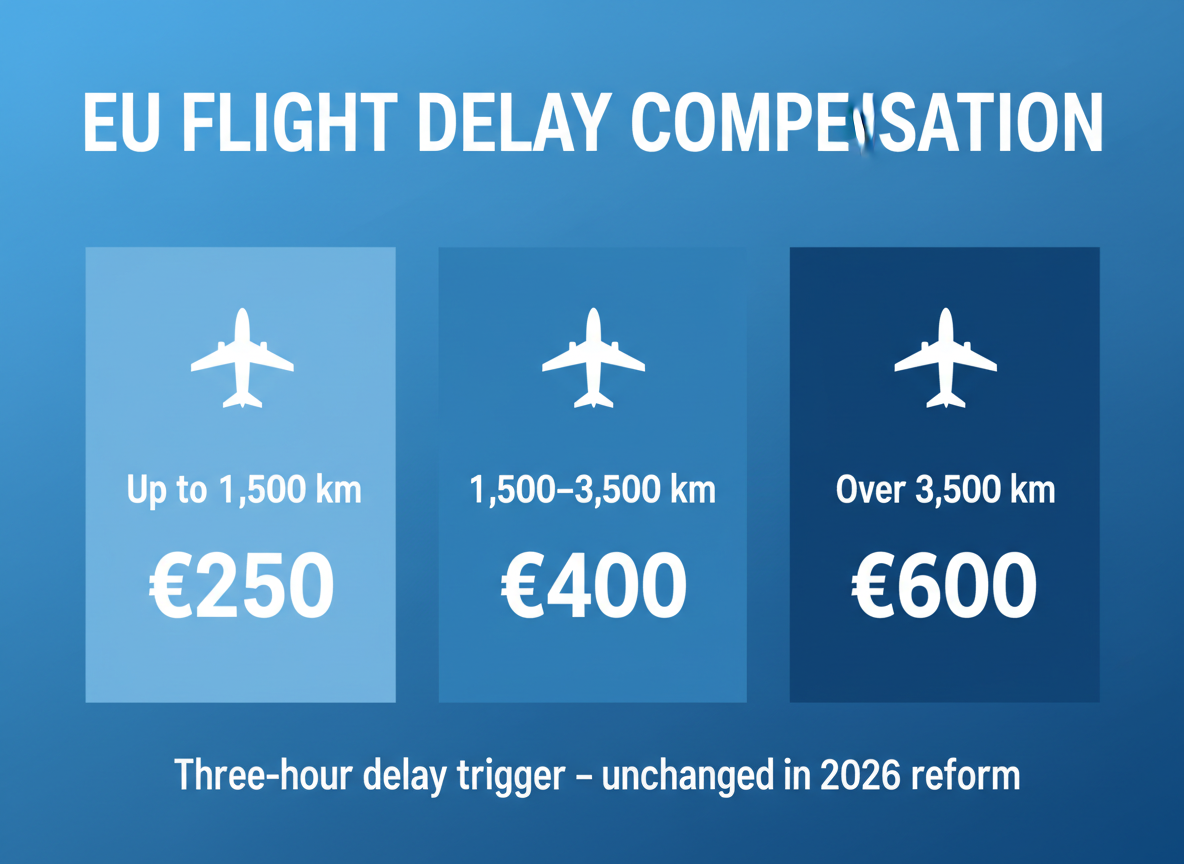
If you have read that compensation “improved” in July 2026, it did not. It survived.
What changed that nobody reported?
Two deadlines moved, and one of them moved against you.
The window to file a compensation claim is nine months in the final text. Parliament’s second-reading position in January 2026 had proposed one year, and a good deal of coverage still repeats the twelve-month figure. Going the other way, airlines get 30 days to actually pay once a claim is settled, and must send a pre-filled claim form after a disruption rather than waiting to be chased.
Family seating is the other one that drifted. The adopted text covers anyone accompanying a child below the age of 14, plus passengers with disabilities and pregnant women, who must be seated together at no extra cost. Several outlets reported the threshold as 12.
Neither correction is dramatic. Both are the kind of thing that decides an actual claim, and both are wrong in a lot of what currently ranks for these searches — much of which is published by companies that take a commission on the claims they are describing.
So what should you actually do?
I have not tested any of this at a gate; this is a reading of the Parliament and Council releases and the A4E commitment, not a trip report. What the primary sources support:
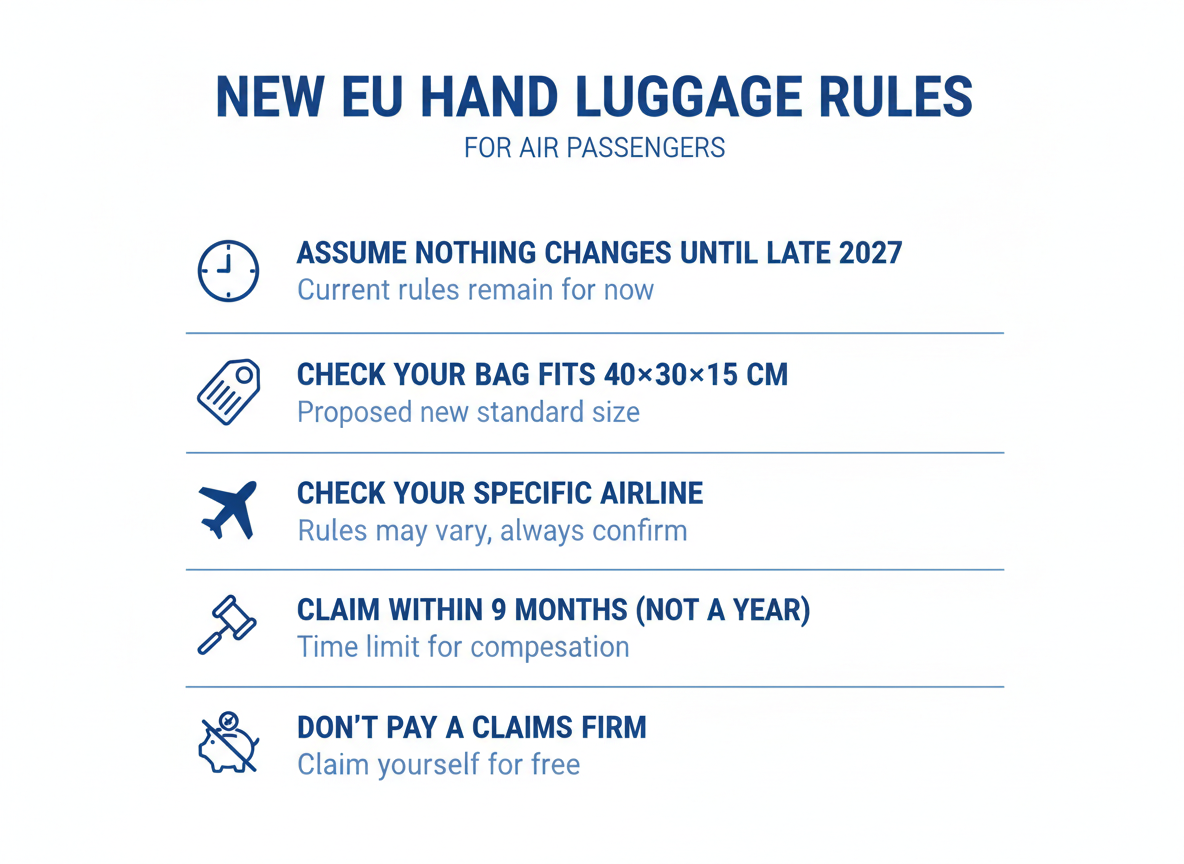
- Assume nothing has changed until late 2027 at the earliest. The act was not in the Official Journal when this was written, and the clock only starts there.
- Measure your under-seat bag against 40 × 30 × 15 cm now. That is what you have today, from a voluntary commitment, on most European carriers.
- Check your specific airline rather than the EU rule. A voluntary standard binds A4E members; your carrier may not be one, and may be more generous anyway.
- Claim within nine months, not a year — for disruptions once the new rules apply. The old regulation’s national limitation periods still govern anything happening now.
- Don’t pay a claims firm a commission for a form the airline will soon have to send you pre-filled. That obligation is one of the genuine wins in this reform.
For the other half of what you can carry through a European airport, the 100ml liquid rule is still in force at most airports despite the scanners that were supposed to end it — a rule that has now outlived several confident predictions of its death.
 Tried and Typed
Leave a comment