

By Ashish Akotkar · 29 August 2026
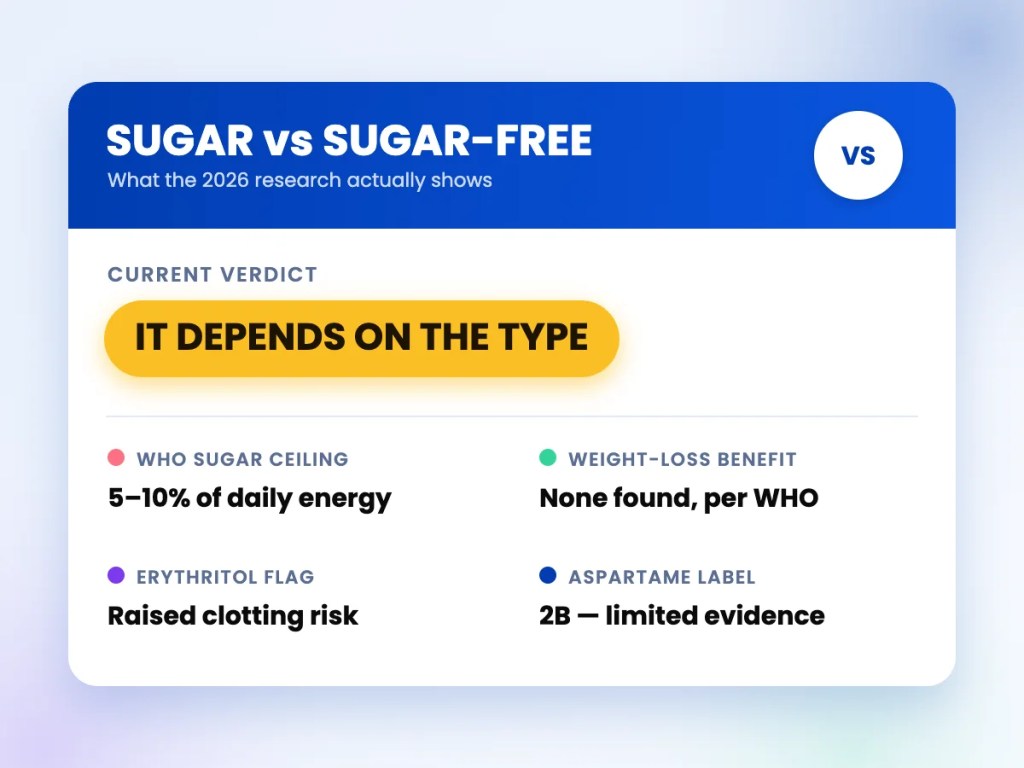
TL;DR: “Sugar-free” is not one thing. It can mean a near-zero-calorie sweetener like aspartame or stevia, or a sugar alcohol like erythritol that still carries some calories and, per recent research, its own separate risks. WHO’s own 2023 guideline says non-sugar sweeteners don’t help with long-term weight control and flags a conditional link to higher rates of type 2 diabetes, cardiovascular disease and death. A run of studies from 2024 through 2025 has tied erythritol specifically to increased blood-clotting activity and cardiovascular events, and a June 2026 review found several common sweeteners measurably affect insulin and blood sugar through the gut microbiome. None of that makes sugar the safer default — it means “sugar-free” isn’t shorthand for “better,” and the honest answer depends on which sweetener, how much, and what you’re managing health-wise.
“Sugar-free” sells itself as the obviously healthier choice — it’s on diet soda, protein bars, gum, coffee syrups, anything trying to look virtuous next to the full-sugar version. But the label covers three chemically and metabolically different categories of ingredient, and the research on each has moved fast enough in the last two years that a lot of the received wisdom is already out of date. Here’s what the primary sources — WHO, the FDA, and the actual clinical studies — say as of today, rather than what the packaging implies.
What does “sugar-free” actually mean?
The FDA recognizes two genuinely different groups under that label. High-intensity sweeteners — aspartame, sucralose, acesulfame potassium, saccharin, neotame, advantame, plus the plant-derived steviol glycosides (stevia) and monk fruit extract — are hundreds of times sweeter than sugar by weight and contribute, in the FDA’s words, “only a few to no calories.” Sugar alcohols — erythritol, xylitol, sorbitol, maltitol — are a separate category the same FDA guidance describes as “slightly lower in calories than sugar,” not calorie-free. Products get to call themselves “sugar-free” using either category, or a blend, and the label doesn’t tell you which.
What’s actually wrong with sugar, for the record?
WHO’s guideline is specific: adults and children should keep free sugars under 10% of total daily energy, with a further reduction to below 5% — roughly 25 grams, or six teaspoons, a day — for additional benefit. The evidence behind it is largely dental: WHO points to higher rates of tooth decay when free sugars run above that 10% line, alongside the weight gain that comes with the extra calories. Neither claim is that sugar in any amount is harmful — it’s that typical Western intake runs well past that ceiling, and the health cost shows up at the margin, not from an occasional dessert.
Does swapping in a sweetener actually help you lose weight?
WHO looked at this directly in its 2023 guideline on non-sugar sweeteners (NSS) and concluded that “use of NSS does not confer any long-term benefit in reducing body fat in adults or children.” More pointedly, it flagged that the evidence “suggest[s] that there may be potential undesirable effects from long-term use of NSS, such as an increased risk of type 2 diabetes, cardiovascular diseases, and mortality in adults.”
Two caveats WHO itself attaches to that: the recommendation is conditional, because the underlying studies could be confounded by who tends to choose diet products in the first place, and it explicitly does not apply to people already living with diabetes. It’s a call to not expect a metabolic free pass from swapping sweeteners — not a verdict that they’re dangerous at typical intake.
Should the aspartame cancer headlines worry you?
In July 2023, two different WHO-affiliated bodies reviewed the same aspartame evidence and reached two different-sounding conclusions, which is exactly why the story got confusing. IARC, which classifies hazards rather than assessing real-world risk, put aspartame in Group 2B — “possibly carcinogenic to humans” — based on what it called limited evidence for liver cancer. JECFA, the joint WHO/FAO committee that actually sets safe intake limits, reviewed the same data and left the acceptable daily intake unchanged at 40 mg per kg of body weight. WHO’s own worked example: an adult weighing 70 kg would need to drink more than 9 to 14 cans of diet soda a day, every day, to exceed that limit — far past what typical consumption looks like. The FDA’s separate ADI for aspartame is even higher, at 50 mg/kg. Different regulators use slightly different numbers, but both leave a wide margin over how the product is actually used.
What’s the specific concern with erythritol?
This is where the newest research is least reassuring. A Cleveland Clinic study published in August 2024 gave 20 healthy volunteers a single serving of erythritol — about what’s in a sugar-free soda or muffin — and measured blood levels spike to over 1,000 times baseline, along with significantly increased platelet aggregation (the blood-clotting response) compared with a glucose control. That built on earlier work from the same group linking high circulating erythritol to roughly double the three-year risk of heart attack or stroke in cardiac patients, and a 2025 analysis in JACC: Advances found a similar association in a separate cohort of older adults.
The researchers are careful to say this shows a plausible clot-forming mechanism, not proven causation, and they’re calling for longer controlled trials. In the meantime, the specific recommendation from the Cleveland Clinic team is that people already at elevated clotting risk — those with heart disease, diabetes, or metabolic syndrome — may be better off choosing an occasional sugar-sweetened treat over routine erythritol-sweetened products, and worth raising with a doctor rather than assuming “sugar-free” is automatically the safer pick for that group.
Does “sugar-free” quietly mess with metabolism through gut bacteria?
A review out of Tufts University, published in Current Atherosclerosis Reports on 30 June 2026, looked back across 21 randomized clinical trials in adults and concluded that artificial and low-calorie sweeteners are metabolically active rather than biologically inert, as long assumed. Against non-caloric controls, they raised fasting insulin and HbA1c and showed a trend toward worsening insulin sensitivity. The proposed mechanism runs through gut bacteria: one of the trials reviewed paired detailed microbiome profiling with experiments transferring microbes from human participants into mice, which is a fairly direct way of implicating the microbiome rather than the sweetener acting on the body directly.
The review’s own caveats matter here: the individual metabolic shifts were small, and the researchers say it’s unclear whether they’re clinically meaningful for any one person. They also flagged a real gap in how these products are labeled — manufacturers have to list sweeteners in the ingredients but not the amount included, which senior author Dariush Mozaffarian noted makes it hard to assess how much people are actually consuming.
So — sugar or sugar-free?
There isn’t a single winner, because “sugar-free” isn’t a single thing. Here’s how the three categories actually compare on what the current research flags:
| Category | Examples | Calories | Current research flag |
|---|---|---|---|
| Sugar | Sucrose, syrup, honey | ~4 kcal/g | Dental caries and excess weight above WHO’s 5–10% ceiling — a dose problem, not a toxicity one |
| High-intensity sweeteners | Aspartame, sucralose, acesulfame-K, stevia, monk fruit | Near zero | No proven weight-loss benefit; aspartame’s 2B hazard label at typical intake is far under the ADI; emerging insulin/microbiome signal from 2026 review |
| Sugar alcohols | Erythritol, xylitol, maltitol, sorbitol | ~2–3 kcal/g | Erythritol specifically linked to raised clotting activity and cardiovascular events in 2024–2025 studies |
Sugar itself is fine within WHO’s target range — the problem is that most people are well past it. Sweeteners aren’t a shortcut around that math, and depending which one is in the product, they carry their own open questions rather than a clean bill of health.
Quick-reference checklist
- Check which category a “sugar-free” product actually uses — high-intensity sweetener or sugar alcohol — since the research differs by type, not by the umbrella label.
- Don’t expect a sweetener swap alone to produce durable weight loss; WHO’s own review found no long-term benefit.
- If you have heart disease, diabetes, or metabolic syndrome, the erythritol research is specific enough to raise with your doctor rather than ignore.
- Aspartame’s cancer classification reflects “possible, limited evidence” at typical intake, not a confirmed risk — worth reading the actual JECFA/IARC statements rather than the headline.
- Watch for the labeling gap: current labels don’t disclose how much sweetener is in a serving, so dose is one thing you currently can’t check for yourself.
It’s the same pattern this site keeps running into with wellness products: the marketing claim moves faster than the citation behind it. We found the same gap recently checking what speed the actual research supports for typing on a walking pad, against what the product guides simply assert.





Leave a Reply