

By Ashish Akotkar · 3 September 2026
The EES border check has been mandatory at Schengen external borders since 10 April 2026, and most of the advice written about it is still describing a system that had not launched yet. Some of it is wrong in a way that matters at the front of the queue.
I have not been through an EES lane myself, so nothing below is a traveller’s tale. It is the Commission’s own documentation, the regulation that created the system, and openly attributed reporting from people who have queued.
TL;DR: Every non-EU national on a short stay gets registered — visa or no visa. First crossing takes four fingerprints and a facial image; later ones reuse them. Under-12s skip the fingerprints. Your passport is no longer stamped. The pre-registration app only works in two countries, and the queues at the big hubs have roughly doubled year on year.
- Who does the EES border check actually apply to?
- What happens at the kiosk on your first crossing?
- How long does EES registration take?
- Can you pre-register and skip the queue?
- Which countries actually run EES?
- Is your passport still stamped?
- What happens to your fingerprints afterwards?
- What should you check before your next Schengen arrival?
Who does the EES border check actually apply to?
Every non-EU national travelling for a short stay of up to 90 days in any 180-day period. That is the whole test. It does not matter whether you need a visa.
This is worth stating flatly, because two of the visa-services sites currently ranking for this question say the opposite — that EES is for visa-required travellers and ETIAS is for visa-exempt ones. The European Commission’s own comparison puts EES at “all non-EU nationals travelling for a short stay,” and reserves the visa-free distinction for ETIAS, which is a separate system and still is not running. An American, a Brit and an Indian national arriving in Frankfurt are all registered by EES. Only the Indian traveller also needs a visa.
EU and Schengen nationals are outside it entirely, as are most long-stay residents and visa holders.
What happens at the kiosk on your first crossing?
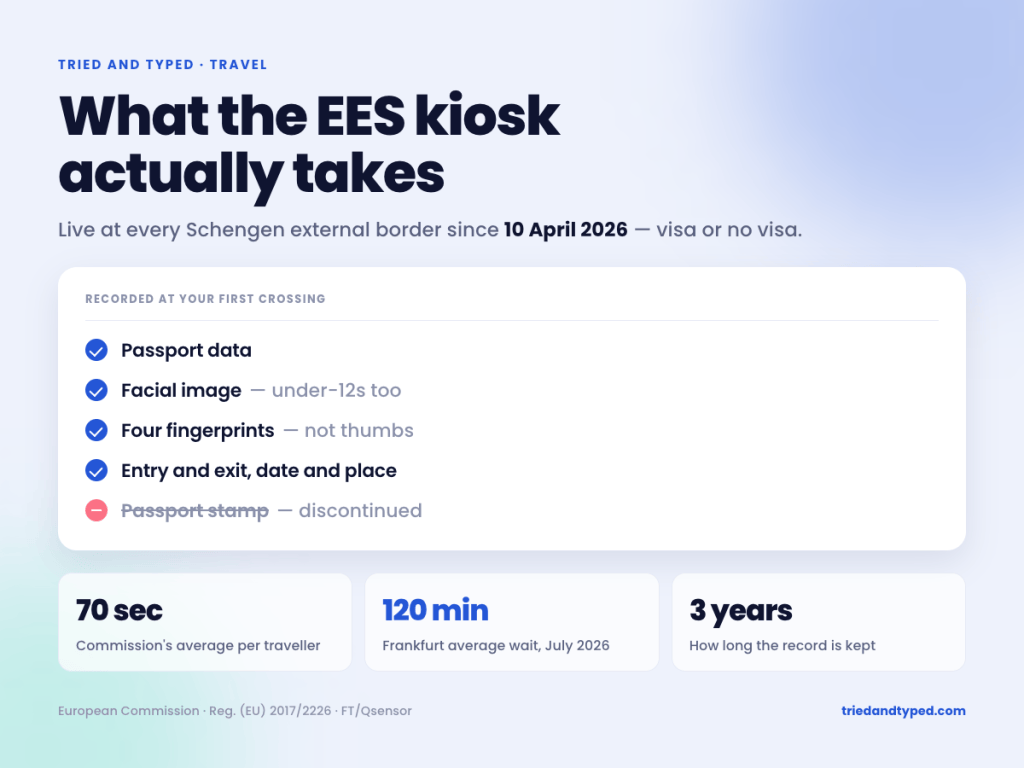
Passport scan, four fingerprints, a photo, and a short questionnaire. The Commission’s EES page lists what gets stored: “the person’s name, travel document data, biometric data (fingerprints and captured facial images) and the date and place of entry and exit.”
Four fingers, not ten, and not thumbs — index, middle, ring and little finger from one hand, with the other hand tried if the read fails. Depending on the border post you will do this at a self-service kiosk before reaching an officer, or at the booth itself.
Every subsequent crossing is faster, because the biometrics are already on file and only need verifying against your face. The slow crossing is the first one, and in April 2026 everybody’s crossing was the first one.
How long does EES registration take?
The Commission’s figure is an average of 70 seconds per traveller in most cases. Measured waits at the busiest airports are a different number.
Frankfurt’s average wait went from 60 minutes in July 2025 to 120 minutes in July 2026, and Munich’s from 31 minutes to about an hour, according to a Financial Times and Qsensor analysis reported by Euronews. Amsterdam’s peak went from 80 to 120 minutes. Ryanair’s chief executive said he had seen large queues at some 15 airports.
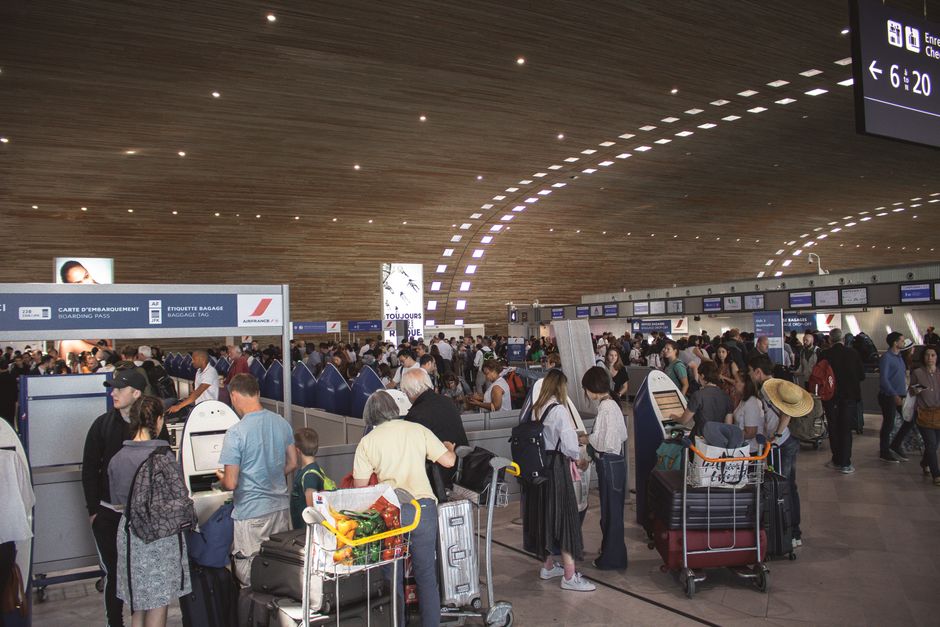
Departures at Paris Charles de Gaulle. The EES queue forms later than this, at passport control — which is why a delay here and a delay there are different problems. Photo: Connor Danylenko / Pexels.
Both numbers can be true. Seventy seconds of transaction time still produces a two-hour queue if the booths are understaffed and everyone in front of you is enrolling for the first time. Budget for the queue, not for the transaction.
Can you pre-register and skip the queue?
Mostly no, and this is where the current advice is most misleading.
The Travel to Europe app is real — Frontex built it to let travellers submit passport data, a facial image and the entry questionnaire before arriving. Frontex is explicit that it “does not replace border checks but aims at making them smoother and faster.” You still stop, and you still give fingerprints in person.
The bigger limitation is coverage. As of July 2026 the app worked only for arrivals into Sweden — at Arlanda, Bromma, Landvetter, Sturup and Skavsta — and in Portugal for the entry questionnaire alone, according to The Local’s survey of member states. Pilots with France, the Netherlands and Italy were planned but not open to travellers. If you are flying into Frankfurt, Schiphol or Madrid, the app does nothing for you.
Which countries actually run EES?
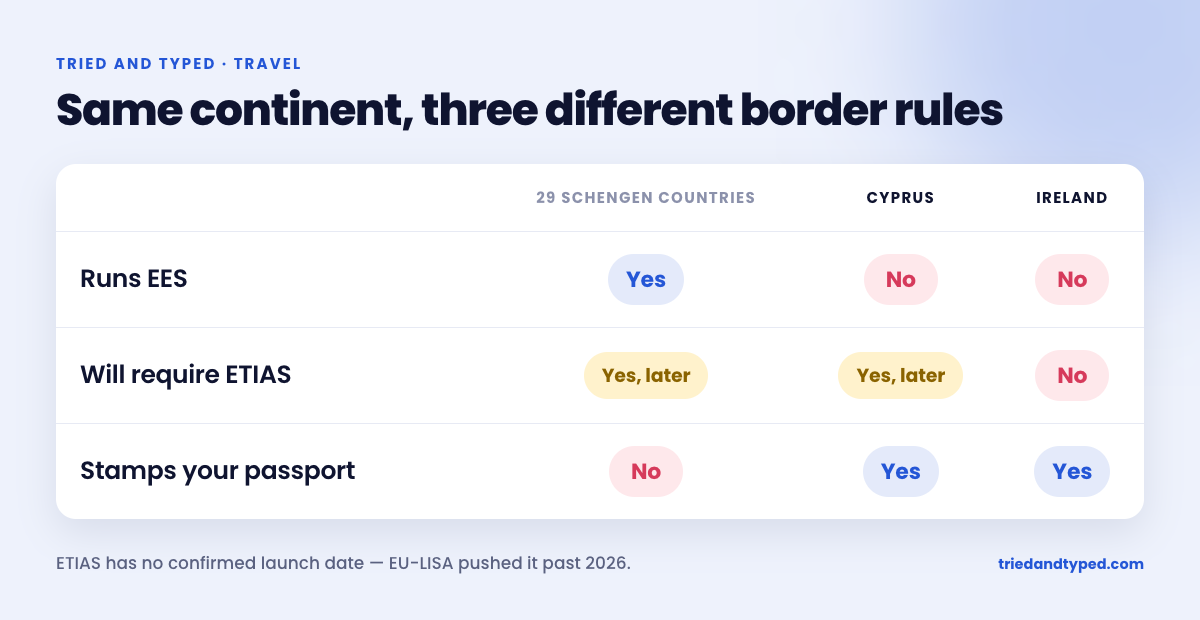
Twenty-nine, which is not the same set as the thirty that will eventually require ETIAS. The difference is two countries and both are easy to get caught by:
- Cyprus will require ETIAS but does not run EES. Passports are still stamped there by hand.
- Ireland runs neither. It is outside Schengen border controls, so it stamps too.
If your trip includes Dublin or Larnaca, you are dealing with the old rules and the new ones on the same itinerary.
Is your passport still stamped?
No. As of 10 April 2026 the EES “replaces the stamping of passports” at participating borders, per the Commission. The stamp was how the 90-in-180 rule used to be counted, by hand, badly.
Now it is counted automatically, which is the actual point of the system: it exists to detect overstays. If you have been treating a missed stamp as useful ambiguity, that is over.
What happens to your fingerprints afterwards?
They are kept for three years, and longer if you overstay. Regulation (EU) 2017/2226, which created the EES, stores each entry/exit record “for three years following the date of the exit record.” Where there is no exit record — the definition of an overstay — the retention period is five years from the last entry, and the system flags member states three months before that data is erased.
Children under 12 are not fingerprinted at all. They still get a facial image and a document check.
What should you check before your next Schengen arrival?
- Assume you will be enrolled, whatever your nationality or visa status
- Add an hour at a major hub for a first crossing; check your connection can absorb it
- Do not pay a third-party site for EES anything — there is no application and no fee
- Check the app only if you are flying into Sweden; elsewhere it will not help yet
- Expect a manual stamp in Dublin and Larnaca, and no EES record from either
- If you are close to the 90-day limit, count it yourself before you travel — the border now does
Related: ETIAS 2026: Is It Actually Required Yet? and The 100ml Liquid Rule in 2026, which is the other EU travel rule that varies by the specific airport you are standing in.





Leave a Reply