

By Ashish Akotkar · 28 August 2026 · Updated 4 October 2026
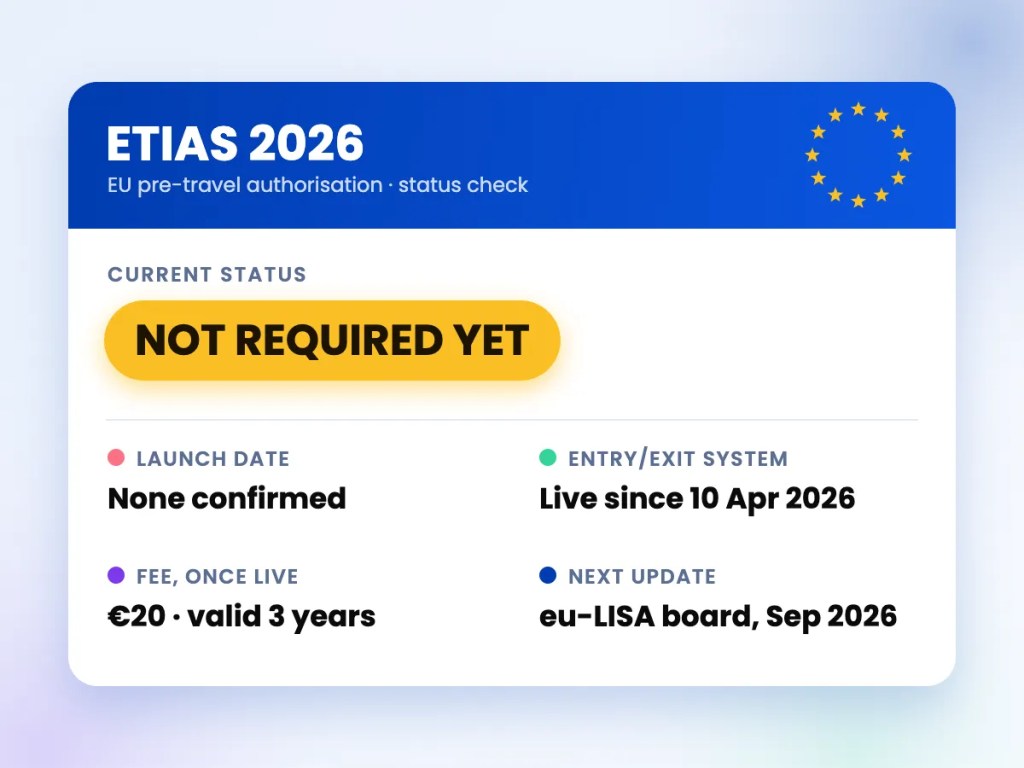
TL;DR: ETIAS is still not required — and we are now inside the quarter that some of the EU’s own pages still promise it for. The eu-LISA management board met on 23–24 September 2026 and set no launch date. The European Commission’s ETIAS page has dropped any date at all; the EU’s diplomatic service and national tourism boards still tell travellers it starts in the last quarter of 2026. The system it depends on, the Entry/Exit System (EES), has been fully operational since 10 April 2026 and caused multi-hour queues at some Schengen airports over the summer. If a site is charging you a fee for an “ETIAS application” right now, it’s not legitimate — the portal isn’t open.
Search “ETIAS 2026” and you’ll get a dozen confident, contradictory answers: some still name a date this quarter, some say April 2027 is now mandatory, a few have “coming this year” copy that hasn’t been touched since the date last moved. That’s not because anyone’s lying — ETIAS has been delayed enough times that most articles are simply stale by the time you read them. Here’s what’s actually true as of today, sourced from the EU’s own pages rather than a roundup of other roundups.
Do you need ETIAS to travel to Europe right now?
No. If you’re a US citizen (or from any of the other roughly 60 visa-exempt countries), you can still enter the Schengen Area for stays of up to 90 days in any 180-day period with nothing more than a valid passport, the same as before. ETIAS isn’t a visa — it’s a pre-travel screening and a €20 fee, similar in spirit to the US ESTA — but it hasn’t gone live, so none of that applies yet. Nothing changes for a trip booked this year.
The one thing that has already changed is the Entry/Exit System, which is a separate program and easy to confuse with ETIAS. More on that below.
So when is ETIAS actually launching?
Nobody has a firm date, including the European Commission — and the EU has not finished telling itself that. The Commission’s own ETIAS page now carries no date at all, only that the EU “will inform about the specific date for the start of ETIAS several months prior to its launch.” But the European External Action Service, the EU’s own diplomatic service, still states flatly that “ETIAS will start operations in the last quarter of 2026,” and national tourism boards including Austria’s repeat it word for word. That quarter began in October. Financial Times reporting has pointed to 2027 as the more realistic window, and one EU official described any further slip as likely being “brief” — an extra quarter or month — rather than another multi-year delay.
That checkpoint has now passed, and it produced nothing. The eu-LISA management board — eu-LISA being the agency that actually runs the IT systems — met in Strasbourg on 23 and 24 September 2026 and published a review of its large-scale IT systems and the interoperability roadmap without naming an ETIAS launch date. The board had already concluded in June that a 2026 launch was not achievable. The Commission has said it will set a final date only after eu-LISA finishes testing, which leaves the next board meeting, not a press release, as the thing to watch — and leaves the “last quarter of 2026” still sitting on other EU pages as wrong rather than merely optimistic.
Why does a border system called EES keep coming up in ETIAS articles?
Because ETIAS can’t launch until the Entry/Exit System is stable, and EES has had a rough year. Per the European Commission’s own Migration and Home Affairs page, EES has been fully operational at every external Schengen border crossing since 10 April 2026, and had logged over 145 million entries and exits as of that same page’s last update. EES replaces manual passport stamping with fingerprint and facial-image checks for non-EU travellers, which is exactly the kind of thing that goes smoothly in a pilot and badly at scale.
It went badly enough over the summer that it became a genuine news story. Al Jazeera reported in early July that passengers were facing five-hour queues at some airports, with departure gates closing on flights that were only half full because people hadn’t cleared border control in time. Aviation industry groups asked the EU for the authority to suspend EES checks entirely whenever passenger volume outstrips a border post’s capacity, and the World Travel and Tourism Council warned the disruption could put 41 million arrivals and an estimated $45.4 billion in visitor spending at risk over the July–August peak, when European airports were expecting roughly 40 million more passengers than the two months prior.
That’s the real reason ETIAS keeps slipping. Layering a second new border-screening requirement on top of a system that’s already straining doesn’t look appealing to anyone right now — including, reportedly, EU Home Affairs Commissioner Magnus Brunner, who has pointed to insufficient staffing and infrastructure at the national level as part of the problem.
What will ETIAS actually cost, and who’s exempt?
These numbers haven’t changed and aren’t expected to:
- Fee: €20 per traveller, paid once online at the time of application.
- Under 18 or over 70: exempt from the fee.
- Family members of an EU citizen with free-movement rights: exempt from the fee.
- Validity: up to three years, or until your passport expires — whichever comes first — covering unlimited entries in that window without reapplying.
- Refunds: none. The fee is non-refundable whether you’re approved, refused, or simply don’t end up travelling.
Every traveller applies individually — there’s no household or group application, even for children who are fee-exempt.
What should you actually do before your next trip?
Very little, and that’s the point. The most useful thing this article can tell you is what not to do.
- Don’t pay anyone for an “ETIAS application” today. The official portal isn’t open, so any site currently taking payment for one is, at best, charging a markup for a service that doesn’t exist yet, and at worst outright fraudulent. When ETIAS does launch, the only site that matters is the EU’s own travel-europe.europa.eu.
- Don’t rebook or change plans over it. Nothing about your entry requirements changes between now and whenever ETIAS actually goes live, and there’s expected to be a grace period after launch before it becomes mandatory.
- Don’t trust a date just because it is on an official-looking EU page. Several still say the last quarter of 2026. The agency building the system has said that is not happening.
- Do budget extra time for EES if you’re flying into a busy Schengen hub during peak travel weeks — that’s the delay that’s real today, not ETIAS.
- Do check the date again closer to travel if your trip is planned for mid-2027 or later, since that’s the window most current reporting points to.
It’s the same lesson as chasing down any other number that moves faster than the articles written about it: when the official source itself says “check back later,” that’s more reliable than a blog post confidently naming a date the source won’t commit to.
Read next: the EES border check: what actually happens at the kiosk, and which European airports have actually dropped the 100ml liquid rule.





Leave a Reply