


By A. Akotkar · August 24, 2026
Artificial intelligence has moved from research labs into hiring pipelines, classrooms, courtrooms, newsrooms, and everyday chat windows — and the ethical questions have moved right along with it. This isn’t abstract philosophy anymore. The decisions made about AI today are already shaping who gets a job interview, whose face shows up in a scam video, and whose creative work trained the model answering your question. Here’s a plain-English look at the AI ethics debates that actually matter right now, and why they’re harder to ignore with each passing year.
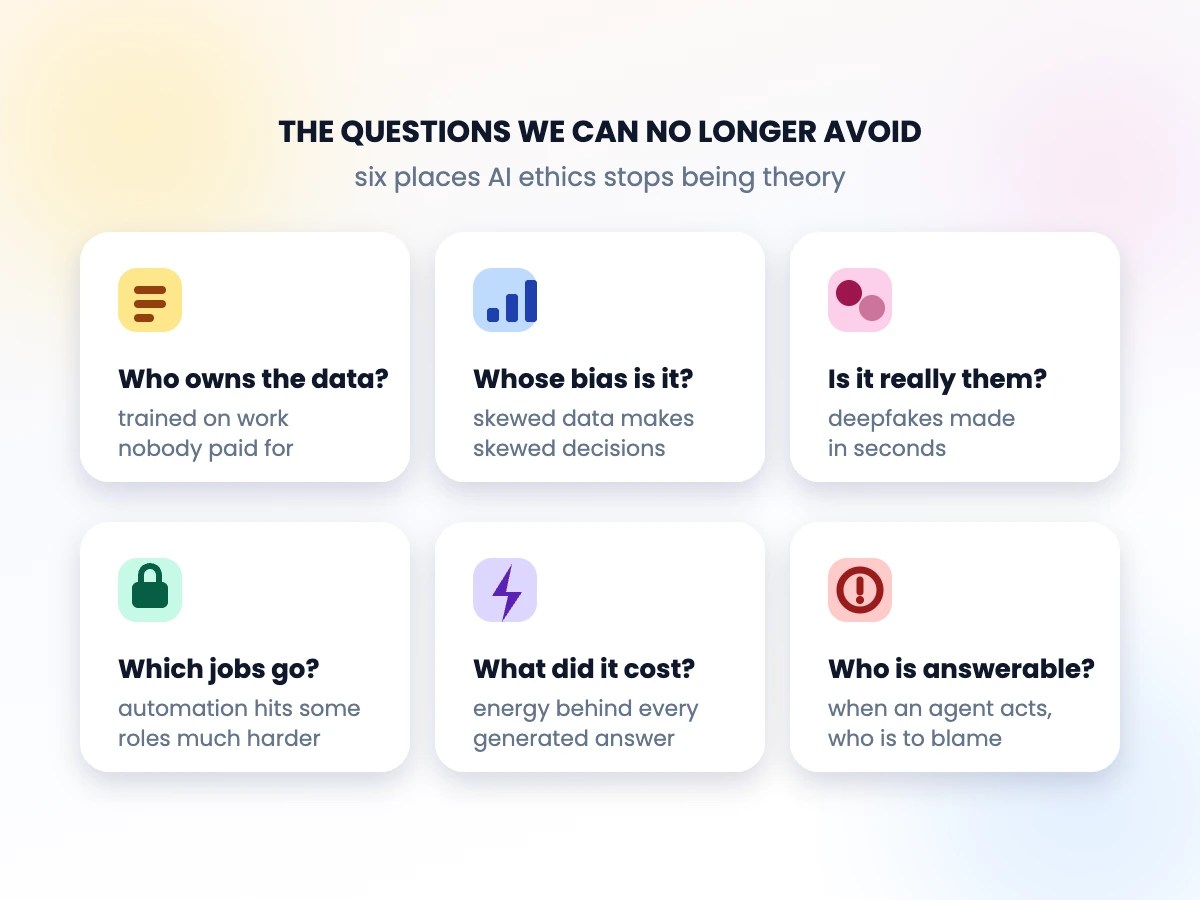
Who owns the data AI learned from?
Every large AI model was trained on enormous amounts of text, images, code, and audio — much of it created by working writers, artists, and developers who never agreed to it. Lawsuits against AI companies over training data have piled up, and publishers are pushing back hard. The debate has shifted from “is this legal?” to “what’s fair?” — with proposals ranging from opt-out registries to consent systems to direct revenue-sharing with the people whose work trained the model in the first place. None of these solutions are fully settled, which means the question of who gets paid for the raw material of AI is still wide open.
What happens to jobs when AI does more of the work?
Entry-level administrative and clerical roles have already seen steep declines as AI tools absorb routine tasks, and tech layoffs tied to AI-driven productivity gains have run into the hundreds of thousands. That’s not automatically a bad thing — plenty of economic shifts create new kinds of work — but the transition is uneven. People with access to AI training and tools are adapting faster than people without it, which risks turning “AI literacy” into a new dividing line in the job market. The ethical question isn’t just whether AI eliminates jobs; it’s who gets left behind while everyone else reskills.
Can we trust AI to be fair?
AI systems used in hiring, lending, and college admissions learn from historical data — and historical data carries historical bias. When a model is trained on decades of biased hiring decisions, it can quietly reproduce that same discrimination at scale, just faster and with less accountability than a single human recruiter. That’s why some jurisdictions have pushed to restrict facial recognition and algorithmic screening in sensitive contexts. The uncomfortable truth is that biased AI doesn’t look biased — it looks like a percentage score, which makes it easier to trust than it should be.
How do we handle deepfakes and AI-generated misinformation?
Synthetic voices and fabricated videos of real people — including public officials — have already been used to spread convincing misinformation. As the tools for generating this content get cheaper and more realistic, the response has focused on two tracks: requiring visible labels on AI-generated media, and creating legal consequences for deepfakes made to deceive or cause harm. Neither approach fully solves the problem, because by the time a fake is debunked, it has often already done its damage.
Who’s responsible when an AI agent makes a mistake?
AI is no longer just answering questions — it’s booking things, writing code, and taking multi-step actions on its own as an “agent.” That raises a genuinely new kind of accountability question: if an autonomous AI agent causes harm, who’s responsible — the company that built the model, the business that deployed it, or the person who set it loose without checking its work? A growing number of proposals now call for every organization using AI agents to name an actual human who’s accountable for the outcomes, rather than letting responsibility disappear into the system itself.
Can we actually see how AI makes decisions?
Modern AI models are famously a “black box” — even the engineers who build them can’t always explain exactly why a model produced a specific answer. That’s a serious problem when AI is influencing medical, legal, or financial decisions. Explainable AI — techniques designed to make a model’s reasoning more visible and auditable — has gone from a research niche to something regulators are starting to demand, especially for high-impact applications where a wrong answer has real consequences for real people.
What does AI cost the planet?
Training and running large AI models takes enormous amounts of electricity and water to cool data centers. Some projections suggest data centers’ share of total US electricity demand could triple within just a few years. That environmental cost rarely shows up in the conversation when people marvel at what a chatbot can do, but it’s a real trade-off — and one that’s easy to ignore until the infrastructure and utility bills start piling up.
So where does that leave the rest of us?
None of these debates have tidy answers yet, and anyone who tells you otherwise is probably selling something. But there are a few practical habits worth adopting, whether you’re building with AI or just living alongside it:
- Ask where the data came from before you trust an AI-generated answer or image.
- Treat AI output in high-stakes contexts (hiring, healthcare, finance) as a draft that needs human review, not a verdict.
- Look for labels on AI-generated media, and be skeptical of anything designed to provoke a strong, fast emotional reaction.
- If your workplace uses AI agents, ask who’s actually accountable when something goes wrong — “the AI did it” isn’t an answer.
AI ethics isn’t a side conversation to the technology anymore — it’s the main event. The tools are moving fast, but the questions of who benefits, who’s protected, and who’s accountable are the ones that will actually determine whether this technology ends up serving people or just running past them. That’s a conversation worth having in plain language, not just in policy papers.




Leave a Reply