


By A. Akotkar · August 24, 2026
“What is AI” recently became one of the most-searched questions on Google worldwide — which is a little strange, given how long the term has been around. The honest answer is that AI isn’t one thing. It’s a label that gets stretched over everything from the autocomplete on your phone to a chatbot that can write code, and that stretching is exactly why the question keeps coming up. Here’s a plain-English breakdown, no hype and no jargon.
The short definition
Artificial intelligence is software that performs tasks which normally require human judgment — recognizing images, understanding language, making predictions, generating text — by finding patterns in large amounts of data, rather than following rules a programmer wrote out by hand. That’s it. It’s not a robot with opinions, and it’s not a single unified “brain.” It’s pattern-matching at a scale no human could do manually, wrapped in an interface that makes it feel conversational.
The three flavors you’ll actually run into
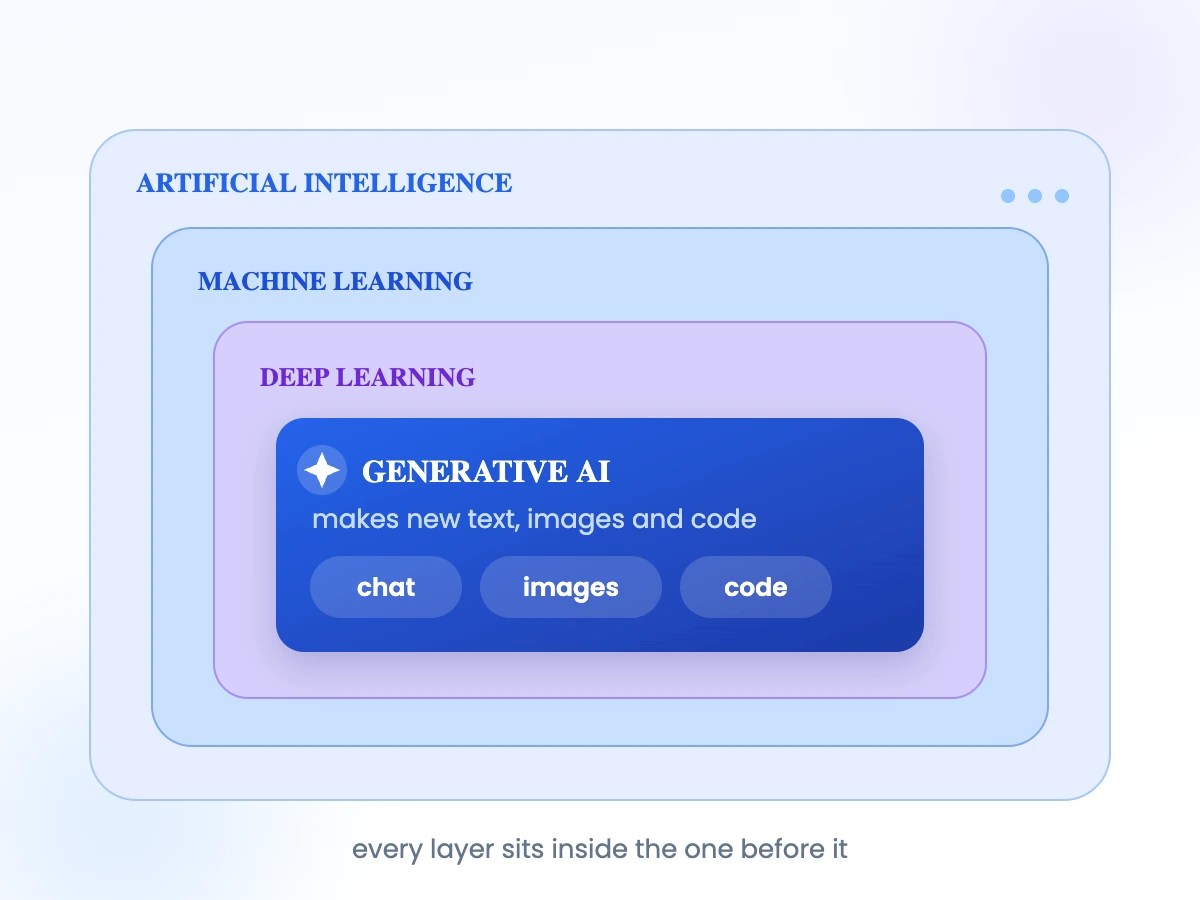
Machine learning is the foundation: software that improves at a task by training on examples instead of being explicitly programmed for every case. Your email spam filter and your bank’s fraud detection are both machine learning, quietly working in the background for years before “AI” became a household word.
Generative AI is the part that took over the conversation — tools like ChatGPT, Claude, and image or video generators that produce new text, images, audio, or video rather than just classifying or predicting. These are built on large language models: systems trained on enormous amounts of text that learn statistical patterns in language well enough to generate convincingly human-sounding output.
AI agents are the newest layer: instead of just answering a question, an agent takes multi-step action on its own — browsing the web, running code, booking things, editing files — checking its own results as it goes. This is the part still most likely to surprise you, for better and for worse.
What AI is not
It’s not sentient, and it doesn’t “understand” the way a person does — it’s predicting the most statistically likely next word, pixel, or action based on its training. It’s not always right, even when it sounds confident; that’s the well-known “hallucination” problem, where a model states something false with total fluency. And it’s not magic: every capability traces back to the data it was trained on, which is also where most of its biases and blind spots come from.
Where you’re probably already using it
- Search engines that summarize answers instead of just listing links
- Autocomplete and grammar suggestions in your email or docs
- Photo apps that recognize faces or auto-enhance images
- Streaming and shopping recommendations
- Chatbots for customer support, writing help, or coding assistance
Why the question matters more now
AI stopped being a background technology and became something people interact with directly, every day, often without a clear sense of what’s actually happening behind the response. That gap between using a tool and understanding it is exactly where the more interesting questions start — who’s accountable when it’s wrong, whose data trained it, and what it costs to run. We dug into those in our AI ethics deep dive, which is a natural next read once the “what is it” question is out of the way.





Leave a Reply